ALL ARTICLES
POLITICS|CRIME|BUSINESS|TECHNOLOGY|WEATHER|ENTERTAINMENT|SPORTS|CULTURE|HISTORY|OPINION|RETURN TO MAIN PAGE
Staff Reporting
#00538
Severe Thunderstorms Hit San Diego County: Marble-Sized Hail, Lightning Strikes Reported
By Dale Kessler, Weather & Climate Reporter  |  CAL WIRE  |  Friday, August 7, 2026
#00537
Lightning and Hail Hitting San Diego County Right Now: What We Know
By Dale Kessler, Weather & Climate Reporter  |  CAL WIRE  |  Friday, August 7, 2026
#00532
The Unglamorous Empire Built on Hollywood's Dirty Laundry
By Jamie Voss, Entertainment Reporter  |  CAL WIRE  |  Thursday, August 6, 2026
#00525
A Utility Tower Sparked the Eaton Fire. Now Comes the Reckoning.
By Danny Sharp, Culture & Arts Reporter  |  CAL WIRE  |  Wednesday, August 5, 2026
#00506
The Unglamorous Art of Making Hollywood Sound Like Anywhere But Hollywood
By Jamie Voss, Entertainment Reporter  |  CAL WIRE  |  Tuesday, August 4, 2026
#00501
California Nearly Had Universal Health Care. Now It's Watching Millions Lose Coverage Instead.
By Danny Sharp, Culture & Arts Reporter  |  CAL WIRE  |  Tuesday, August 4, 2026
#00498
Santa Cruz Shooting Arrest: 3 Taken Into Custody in Circles Neighborhood Case
By Marcus Webb, Crime & Public Safety Reporter  |  CAL WIRE  |  Tuesday, August 4, 2026 · Updated August 4, 2026
#00497
Shooting Report Near Santa Cruz Beach Boardwalk Triggers Evacuation, Heavy Police Response
By Marcus Webb, Crime & Public Safety Reporter  |  CAL WIRE  |  Tuesday, August 4, 2026 · Updated August 4, 2026
#00496
California's 10 Most Car-Theft-Ravaged Cities, Ranked
By Marcus Webb, Crime & Public Safety Reporter  |  CAL WIRE  |  Monday, August 3, 2026
#00495
The 10 Most Senior-Friendly Cities in California Right Now, Ranked
By Danny Sharp, Culture & Arts Reporter  |  CAL WIRE  |  Monday, August 3, 2026
#00494
California's 10 Deadliest Counties for Heart Disease, Ranked
By Danny Sharp, Culture & Arts Reporter  |  CAL WIRE  |  Monday, August 3, 2026
#00478
California's Home Insurance Nightmare Is Getting Worse and Somebody Needs to Answer for It
By Cal Wire Staff  |  CAL WIRE  |  Sunday, August 2, 2026 · Updated August 2, 2026
#00461
The Readers Who Run Hollywood — and Nobody Ever Talks About Them
By Cal Wire Staff  |  CAL WIRE  |  Saturday, August 1, 2026 · Updated August 2, 2026
#00450
F-35B Fighter Jet Crashes at MCAS Miramar in San Diego: What We Know
By Cal Wire Staff  |  CAL WIRE  |  Saturday, August 1, 2026 · Updated August 2, 2026
#00446
California's Governor Is Making More Money Than He Wants to Talk About
By Cal Wire Staff  |  CAL WIRE  |  Saturday, August 1, 2026 · Updated August 2, 2026
#00443
For the Second Time, Sacramento Couldn't Fix the Law That Lets Bad Teachers Keep Teaching
By Cal Wire Staff  |  CAL WIRE  |  Friday, July 31, 2026 · Updated August 2, 2026
#00428
'Spider-Man: Brand New Day' Is Already Beating Records Nobody Expected It to Beat
By Cal Wire Staff  |  CAL WIRE  |  Friday, July 31, 2026 · Updated August 2, 2026
#00426
The Zip Code That Built the Dream: How a Handful of Hollywood Streets Still Rule the Industry
By Cal Wire Staff  |  CAL WIRE  |  Thursday, July 30, 2026 · Updated August 2, 2026
#00425
A Bay Area Pastor Built an AI Clone of Himself So God Is Never More Than a Text Away
By Cal Wire Staff  |  CAL WIRE  |  Thursday, July 30, 2026 · Updated August 2, 2026
#00423
A Bay Area Pastor Built an AI Version of Himself So God Is Never More Than a Text Away
By Cal Wire Staff  |  CAL WIRE  |  Thursday, July 30, 2026 · Updated August 2, 2026
#00422
Kelsey Plum to Golden State? The Valkyries Have a Real Shot at Landing a Superstar
By Cal Wire Staff  |  CAL WIRE  |  Thursday, July 30, 2026 · Updated August 2, 2026
#00409
How Gen Z Fell Back in Love With the Big Dumb Blockbuster
By Cal Wire Staff  |  CAL WIRE  |  Thursday, July 30, 2026 · Updated August 2, 2026
#00404
The Teen in the Vineyard Who Finally Has a Name
By Cal Wire Staff  |  CAL WIRE  |  Thursday, July 30, 2026 · Updated August 2, 2026
#00401
Gavin Newsom's Secret Push for California Forever Has a Very Old Playbook
By Cal Wire Staff  |  CAL WIRE  |  Wednesday, July 29, 2026 · Updated August 2, 2026
#00394
The Padres Are Running Out of Time to Fix What's Obviously Broken
By Cal Wire Staff  |  CAL WIRE  |  Wednesday, July 29, 2026 · Updated August 2, 2026
#00387
The Studio That Burned Down Three Times and Still Wouldn't Die
By Cal Wire Staff  |  CAL WIRE  |  Wednesday, July 29, 2026 · Updated August 2, 2026
#00385
Glen Hansard Dead at 56: Oscar-Winning 'Once' Singer Killed in Motorcycle Crash
By Cal Wire Staff  |  CAL WIRE  |  Wednesday, July 29, 2026 · Updated August 2, 2026
#00376
Cal State Long Beach Just Put a Drone Between Swimmers and Sharks
By Cal Wire Staff  |  CAL WIRE  |  Wednesday, July 29, 2026 · Updated August 2, 2026
#00374
The Santa Cruz Lifeguard Who Earned a White House Invitation Has a Famous Predecessor
By Cal Wire Staff  |  CAL WIRE  |  Tuesday, July 28, 2026 · Updated August 2, 2026
#00354
Universal Studios Hollywood Is About to Strap Riders Into the Fast Lane
By Cal Wire Staff  |  CAL WIRE  |  Monday, July 27, 2026 · Updated August 2, 2026
#00338
The Last Backlot: How Hollywood's Outdoor Stages Survived Malls, Condos, and the Streaming Wars
By Cal Wire Staff  |  CAL WIRE  |  Monday, July 27, 2026 · Updated July 27, 2026
#00331
The Shove Heard Across a State: How One Burning Car Became California's Fourth-Largest Wildfire
By Cal Wire Staff  |  CAL WIRE  |  Sunday, July 26, 2026 · Updated July 27, 2026
#00325
The Bone Room: How UC Berkeley Built America's Largest Native Remains Collection, and Is Now Giving It Back
By Cal Wire Staff  |  CAL WIRE  |  Sunday, July 26, 2026 · Updated July 27, 2026
#00320
The Last Bear: How Monarch the Grizzly Became California's Flag and Its Ghost
By Cal Wire Staff  |  CAL WIRE  |  Sunday, July 26, 2026 · Updated July 27, 2026
#00260
Wide Right: How Las Vegas Built a Palace for the Raiders and Fumbled the World Cup
By Cal Wire Chief Editor  |  CAL WIRE  |  Thursday, July 23, 2026 · Updated July 27, 2026
Wire Reports
POLITICS >
Federal
Sanders says Minnesota Senate race between progressive and moderate will be 'tight'
Sen. Bernie Sanders (I-Vt.) said he believes the Democratic Senate primary in Minnesota between Lt. Gov. Peggy Flanagan (D), a pro... — The Hill
Max Miller is refusing to drop his bid for reelection. Here's what voters think
Voters in Ohio's 7th Congressional district react to calls for Rep. Max Miller to drop his bid for reelection. He ran unconte... — NPR Politics
How a stronger voter ID law can alleviate doubts in California’s election system
If Californians harbor doubts about their elections, the process needs to be repaired. A former California secretary of state says... — CalMatters
California’s voter ID ballot measure would add unnecessary barriers to a secure system
Prop. 39 is a redundant proposal that will only make it harder for all voters to participate in future elections, argues a civic e... — CalMatters
An esoteric hallucinogen's 'superstar' adherents
Journalist Kimon de Greef travels to the Sonoran desert in the southwestern US, where a powerful yet obscure drug has attracted ev... — Semafor
Rubio Is Trying to Keep Leftists Out of U.S. by Banning Supporters of “Economic Sabotage” — Intercept
Trump unveils new critical minerals investments
The projects include a $1.4 billion loan for batteries, a $400 million loan for scandium, and a $150 million loan for magnets, plu... — Semafor
Democratic establishment uses a ‘vulnerability’ attack on the left
Rep. Angie Craig is warning that fraud investigations could dog her progressive rival for Minnesota Senate, and she’s not alone. — Semafor
Google doesn't need the LLM crown
Whoever stands atop the AI race podium isn’t the main point anymore. — Semafor
Hacks put pressure on third-party model testers
Models from Meta, Anthropic, and OpenAI all accessed the internet and compromised outside organizations while undergoing cybersecu... — Semafor
AI avatars enter the job interview
For some job candidates, using AI in the application process is a reaction to a system that’s grown more machine than human. — Semafor
DeepSeek warns of price increase
The warning shows how Chinese tech companies are balancing their low-cost reputation with a need to actually make money — Semafor
The secret ingredients powering AI chatbots
Some US companies are disclosing they use a cocktail of AI, including some Chinese open-source models, to build custom consumer-fa... — Semafor
State Department Wants Palantir’s Advice on Free Speech and “Countering Digital Surveillance” — Intercept
Cameroon president's absence stirs health speculation
The two-month absence of 93-year-old Paul Biya, who is thought to be in Switzerland, has prompted renewed speculation about his he... — Semafor
Immigration stokes economic anxiety, survey shows
Nearly two-thirds of respondents preferred to see fewer or no job seekers admitted into their country, Ghana-based polling company... — Semafor
Federal
Women in Maine may choose the victor in this year's Senate race
The race between Susan Collins and Troy Jackson is one of the nation's most high-profile Senate contests this year -- and may... — NPR Politics
How a stronger voter ID law can alleviate doubts in California’s election system
If Californians harbor doubts about their elections, the process needs to be repaired. A former California secretary of state says... — CalMatters
California’s voter ID ballot measure would add unnecessary barriers to a secure system
Prop. 39 is a redundant proposal that will only make it harder for all voters to participate in future elections, argues a civic e... — CalMatters

California held its primary election on June 2nd. Today is June 24th. Some races still aren't fully called. Let that sink in.

The state with the largest economy in the Western Hemisphere, home to Silicon Valley and some of the most sophisticated technology companies on earth, cannot tell you who won a mayoral race three weeks after people voted. And the people running California's elections want you to understand that this is fine, actually. It's by design. It's about accuracy and access.

With respect: that's not good enough.

How California Counts Votes

Here's how the system works. California mails a ballot to every one of its 23 million registered voters. Those ballots can be returned by mail — and they are counted as long as they are postmarked by Election Day and arrive at an election office within seven days afterward. If a voter's signature on the ballot envelope doesn't match what's on file, election officials are required to notify the voter and give them an opportunity to come in and verify their identity. In the 2026 primary, the deadline for that signature cure process was June 24th — three weeks after the election.

This is how the LA mayoral race played out this month. Initial Election Night results showed Republican candidate Spencer Pratt — yes, that Spencer Pratt — in second place, with progressive Nithya Raman coming in third. Five days after the election, as late-arriving mail ballots were counted, Raman overtook Pratt and advanced to the runoff. Pratt's supporters immediately cried fraud. Trump posted about it online. The DOJ announced an investigation.

Was there fraud? Almost certainly not. Election experts were clear on that. The shift was entirely predictable — mail ballots tend to skew Democratic, and voters who return them later tend to be more progressive. What happened was math, not manipulation. But the slow count created a perfect environment for conspiracy theories to take root and grow.

The Trust Problem

Here's what the defenders of California's current system don't want to acknowledge: even if the slow count is legitimate, the slow count is a problem. Public trust in elections isn't just about whether the results are accurate. It's about whether people believe the process is fair. And when a result flips five days after an election, in a high-profile race, with no clear explanation from state officials about why that's normal — the trust erodes.

As Thad Kousser, co-director of the Center for Transparent and Trusted Elections at UC San Diego, put it: "The longer it takes to call a race, the further voter confidence falls and the more conspiracies grow."

This is not a partisan observation. It's a civic one. Voting advocates — not Trump supporters, not Republicans, but voting rights advocates — have been urging the state legislature to better fund election offices so they can process ballots faster. Newsom himself signed a bill last year requiring the count to be completed within 13 days rather than 30. That's not fast enough.

What Should Change

Other states run large mail-in elections and count them faster. Colorado has been doing all-mail voting for years and typically has results on election night. The difference isn't magic — it's funding, early processing, and clear deadlines.

California should require mail ballots to arrive by Election Day, not just be postmarked by it. Thirty-six states already have that requirement. The state should also dramatically increase funding to county election offices to allow them to process ballots as they arrive in the weeks before Election Day, rather than facing an avalanche on election night.

None of this requires sacrificing accuracy. It requires Sacramento to treat the speed and transparency of elections as being just as important as their accessibility. Right now, California acts like those are competing values. They're not. A slow count that nobody trusts doesn't serve democracy any better than a fast one.

Three weeks is too long. California can do better. It just needs to decide it wants to.

The Supreme Court is sprinting toward the finish line of its current term, and California is directly in the crosshairs of several of its remaining decisions. With 22 cases still undecided as of this week, the justices are racing to publish opinions before the end of June — and what they decide could reshape gun laws, voting rules, and the balance of power in the federal government in ways that hit Californians immediately.

The Gun Permit Case: California's Law Under Fire

California is one of only five states — along with Hawaii, Maryland, New York, and New Jersey — that requires gun owners to obtain advance permission before bringing a firearm onto private property. The question before the Supreme Court is whether that requirement violates the Second Amendment right to bear arms.

The court's conservative supermajority has been aggressively expanding gun rights in recent years, and legal observers are not optimistic about California's law surviving this ruling. A decision against the state would force Sacramento to rewrite a significant piece of its firearms regulation framework, and would likely trigger immediate legal challenges to other California gun restrictions. The ruling is expected any day now.

In a related case already decided this month, the Supreme Court unanimously ruled that federal law banning drug users from owning guns is unconstitutional. The unanimous decision in US v. Hemani — involving a man arrested with a pistol and marijuana — is the same statute used to convict Hunter Biden in 2024. California, which has its own drug-related gun restrictions, will need to examine how that ruling affects its own statutes.

The Mail Ballot Decision: California's Counting Rules May Be at Risk

This one has Sacramento on edge. The Supreme Court is set to rule on whether states can count mail-in ballots that arrive after Election Day. California currently accepts mail ballots postmarked by Election Day if they arrive within seven days — a rule that has allowed millions of Californians to vote and that is central to how the state runs its elections.

A ruling against these "grace period" policies would not affect California's state races, which are governed by state law. But it could directly invalidate California's rules for federal contests — U.S. House and Senate races — in the November midterms. That means California congressional races, some of which decide House majority control, could be forced into a much faster counting framework than the state currently uses.

Trump vs. Independent Agencies: A Seismic Shift in Federal Power

The case that could have the most far-reaching consequences doesn't involve California by name but will reshape how every Californian interacts with the federal government. The court is expected to rule that President Trump has the authority to fire the leaders of independent federal agencies at will — eliminating a decades-old precedent that kept agencies like the Federal Trade Commission, the Consumer Financial Protection Bureau, and the Federal Reserve Board politically independent.

California has been one of the most aggressive states in using federal agencies — particularly the EPA and CFPB — as allies against Trump administration policies. If those agencies become fully accountable to the White House rather than to Congress or independent mandates, California's legal strategy of fighting Trump through regulatory channels becomes significantly weaker.

Watch for these rulings in the next two weeks. The court's end-of-term sprint is never dull — and this year, it's shaping up to be one of the most consequential in a generation.

CRIME >
Riverside County sheriff's deputies shoot person while responding to mental health crisis
Sheriff's deputies in Moreno Valley shot an unidentified person while responding to a mental health crisis after, according to the... — LA Times
Ex-gubernatorial candidate pleads not guilty to threats in model ex-girlfriend's case
Stephen Cloobeck, a wealthy realtor and one-time Democratic candidate for governor of California, pleaded not guilty to witness ta... — LA Times
Riverside County sheriff's deputies shoot person while responding to mental health crisis
Sheriff's deputies in Moreno Valley shot an unidentified person while responding to a mental health crisis after, according to the... — LA Times
Ex-gubernatorial candidate pleads not guilty to threats in model ex-girlfriend's case
Stephen Cloobeck, a wealthy realtor and one-time Democratic candidate for governor of California, pleaded not guilty to witness ta... — LA Times
Riverside County sheriff's deputies shoot person while responding to mental health crisis
Sheriff's deputies in Moreno Valley shot an unidentified person while responding to a mental health crisis after, according to the... — LA Times
Ex-gubernatorial candidate pleads not guilty to threats in model ex-girlfriend's case
Stephen Cloobeck, a wealthy realtor and one-time Democratic candidate for governor of California, pleaded not guilty to witness ta... — LA Times
Man arrested in Gann fire says he was trying to make money for a birthday dinner
Cal Fire officers took 65-year-old Herbert Wayne Smith into custody on Monday around 7:45 p.m. Detectives believe the Valley Sprin... — LA Times
'Calculated act of violence': Man gets life sentence in racially motivated L.A. Metro stabbing
Gerald Pitts was sentenced to life in prison in a racially motivated stabbing of a Latino passenger on an L.A. Metro bus in Exposi... — LA Times
Ex-gubernatorial candidate pleads not guilty to threats in model ex-girlfriend's case
Stephen Cloobeck, a wealthy realtor and one-time Democratic candidate for governor of California, pleaded not guilty to witness ta... — LA Times
Man arrested in Gann fire says he was trying to make money for a birthday dinner
Cal Fire officers took 65-year-old Herbert Wayne Smith into custody on Monday around 7:45 p.m. Detectives believe the Valley Sprin... — LA Times
'Calculated act of violence': Man gets life sentence in racially motivated L.A. Metro stabbing
Gerald Pitts was sentenced to life in prison in a racially motivated stabbing of a Latino passenger on an L.A. Metro bus in Exposi... — LA Times
Ex-gubernatorial candidate pleads not guilty to threats in model ex-girlfriend's case
Stephen Cloobeck, a wealthy realtor and one-time Democratic candidate for governor of California, pleaded not guilty to witness ta... — LA Times
Man arrested in Gann fire says he was trying to make money for a birthday dinner
Cal Fire officers took 65-year-old Herbert Wayne Smith into custody on Monday around 7:45 p.m. Detectives believe the Valley Sprin... — LA Times
'Calculated act of violence': Man gets life sentence in racially motivated L.A. Metro stabbing
Gerald Pitts was sentenced to life in prison in a racially motivated stabbing of a Latino passenger on an L.A. Metro bus in Exposi... — LA Times
BUSINESS >
Markets
Dow Jones: 54036.93 +151.83 (+0.28%)
S&P 500: 7757.64 +47.68 (+0.62%)
Nasdaq: 26690.62 +342.27 (+1.30%)
Biggest Movers
Top Gainer: Uber (San Francisco) — $75.02 +4.55 (+6.46%)
Top Loser: AMD (Santa Clara) — $483.36 -5.92 (-1.21%)
Sector Snapshot
Information Technology: Apple $313.33 +0.92 (+0.29%)
Financials: JPMorgan Chase $357.52 +1.22 (+0.34%)
Health Care: Eli Lilly $1185.71 -6.23 (-0.52%)
Consumer Discretionary: Amazon $274.48 +2.22 (+0.82%)
Communication Services: Alphabet $354.30 -3.45 (-0.96%)
Industrials: GE Aerospace $370.08 -4.47 (-1.19%)
Consumer Staples: Procter & Gamble $145.79 -1.18 (-0.80%)
Energy: ExxonMobil $153.04 -1.80 (-1.16%)
Utilities: NextEra Energy $84.65 +0.05 (+0.06%)
Real Estate: Prologis $140.16 +1.02 (+0.73%)
Materials: Linde $489.98 -0.13 (-0.03%)
Crypto
Bitcoin $65092.90 +188.21 (+0.29%)
Ethereum $1919.28 +3.75 (+0.20%)
Tether $0.9993 +0.00 (+0.01%)
XRP $1.04 +0.00 (+0.17%)
BNB $607.39 +6.97 (+1.16%)
Solana $77.16 +1.19 (+1.56%)
USD Coin $1.0000 +0.00 (+0.01%)
Dogecoin $0.0704 +0.00 (+0.04%)
Cardano $0.1981 -0.00 (-0.59%)
TRON $0.3297 +0.00 (+0.28%)
Toncoin $0.0054 -0.00 (-0.00%)
Avalanche $6.55 +0.07 (+1.07%)
Shiba Inu $0.0000 -0.00 (-6.60%)
Chainlink $8.33 +0.03 (+0.35%)
Polkadot $0.8082 -0.01 (-0.73%)
California Companies
Uber (San Francisco) — $75.02 +4.55 (+6.46%)
Salesforce (San Francisco) — $192.74 +5.97 (+3.20%)
Tesla (Austin (CA-founded)) — $328.58 +9.05 (+2.83%)
Oracle (Austin (CA-founded)) — $147.02 +3.55 (+2.47%)
Nvidia (Santa Clara) — $223.96 +4.97 (+2.27%)
Intel (Santa Clara) — $101.65 +1.84 (+1.84%)
AMD (Santa Clara) — $483.36 -5.92 (-1.21%)
Alphabet (Mountain View) — $354.30 -3.45 (-0.96%)
Netflix (Los Gatos) — $74.14 +0.45 (+0.61%)
Meta (Menlo Park) — $592.10 +2.20 (+0.37%)
Apple (Cupertino) — $313.33 +0.92 (+0.29%)
Disney (Burbank) — $104.91 +0.23 (+0.22%)
Wall Street put $7B into tokenized funds, but under 1% is actually being used in DeFi — CryptoSlate
Hyperliquid’s RWA perps boom is eating into the revenue that backs HYPE
Revenue has fallen four quarters running while open interest hit a record high. The gap is a fee-sharing program that hands half t... — CoinDesk
Bitcoin investors pour $853 million into spot ETFs. BlackRock’s IBIT claims the bulk — CoinDesk
Never sell treasury model cracks again as 1,635 BTC is offloaded shrinking Empery reserves by 76% in weeks — CryptoSlate
AI financial advisers carry a hidden Bitcoin bias activated by a single specific switch — CryptoSlate
Crypto is going through a massive dot-com style shakeout as over 100 projects fold in 2026
An industry-wide reckoning is weeding out unsustainable startups, leaving behind only the protocols with real cash flow and actual... — CoinDesk
A $1.8 billion leverage trap is building on Solana as traders pay 11-month high rates to defend $78 — CryptoSlate
BIP-110 Bitcoin branch stalls after two blocks as gap widens
The enforcing fork remains stuck at Bitcoin’s full mining difficulty as mandatory signaling proceeds with little hashpower support... — Cointelegraph
Bitcoin split into two chains overnight, but a silent miner boycott just halted the enforcing BIP-110 chain — CryptoSlate
Why crypto ‘audited’ badges are giving investors a dangerous false sense of security — CryptoSlate
Brazil targets crypto fraud with up to 24-hour transfer hold
The rules, effective Jan. 1, 2027, cover transactions above $10,000 sent to overseas providers or self-custody wallets, along with... — Cointelegraph
BTCPay restricts remote Lightning access after attackers steal funds
Foundation and Citadel21 reported drained Lightning nodes, but the total amount stolen and number of affected operators remain unk... — Cointelegraph
Ocasio-Cortez hasn't 'ruled out' running for president or Senate in 2028
The congresswoman, who has emerged as a polling favorite to be the Democratic nominee, said she also has not ruled out a run for t... — CNBC Top
Iran-backed Houthi rebels attack crucial Red Sea port and Saudi Aramco refinery as fighting escalates
Mokha is one of the main ports under Yemen’s internationally recognized government, renovated in recent years to handle shipping t... — Fortune
Eastern Mediterranean Sea is fast becoming an alternative energy source for Europe amid wars in Ukraine and Mideast, Cyprus says
European consumers can expect natural gas from an undersea deposit off Cyprus to help meet their energy needs as early as March 20... — Fortune
Pentagon tells defense execs to submit plans in 3 weeks to boost weapons production dramatically. ‘Years-long development cycles are not acceptable’
The memo comes as recent fighting with Iran used up more of the U.S. military’s already diminished stockpiles of advanced missile... — Fortune
S&P 500 sales growth is at a nearly 5-year high. Here’s what’s behind the surge.
Energy companies in the S&P 500 have put up a 42.5% revenue gain in the second quarter, powering the index’s sales perf... — MarketWatch
5 ‘rules’ your parents taught you that are sabotaging your career, says expert—like ‘always be grateful’
"Well-intentioned career advice absorbed from a young age can work against you," says executive coach Melody Wilding, author of "M... — CNBC Top
‘I don’t wish to be cold-hearted’: My elderly relative can no longer care for himself. Am I wrong to leave his care to the state?
“He has never been particularly generous or nurturing.” — MarketWatch
Corcoran Group CEO says Gen Z’s housing market struggles mirror what boomers faced 30 years ago: ‘Stop buying Starbucks coffee,’ she advises
From skipping coffee runs to hosting dinner clubs, Corcoran Group CEO Pamela Liebman has one message for Gen Z: getting your first... — Fortune
Here are the 2 big things we're watching in the stock market in the week ahead
The market's attention will be on July inflation data. — CNBC Top
CEO of $49 billion AI company says it’s ‘mind-boggling’ people think you can work 38 hours a week, have work-life balance, and be successful
Cerebras cofounder Andrew Feldman warned aspiring entrepreneurs they need to be working “every waking minute,” echoing the likes o... — Fortune
‘This has been an emotionally difficult time’: My brother has cancer and my father is 94. How do I shoulder this responsibility?
“My father placed his $600,000 Wisconsin home into a revocable trust, naming my brother as beneficiary.” — MarketWatch
The number of stocks beating the S&P 500 is the highest in 4 years. Why that number should rise.
For the first time in four years, the average stock is beating the stock market. — MarketWatch

A salmonella outbreak tied to jalapeños is expanding fast — now stretching across 27 states, including California — and it's hitting some of the biggest names in the food business. The USDA says some meat products containing jalapeños may also be linked to the outbreak, widening the scope beyond fresh produce. This is a developing story and details are still coming in.

Chipotle and Qdoba are both named in connection with the outbreak, according to early reports from NBC News. Meanwhile, grocery chain Jewel-Osco has already pulled fresh salsa products containing jalapeños from its shelves. Californians who've recently eaten jalapeño-containing foods at restaurants or bought fresh salsa should pay close attention.

The USDA's warning about meat products is the newest wrinkle. CBS News reports the agency is flagging certain meat items that may have come into contact with or contain contaminated jalapeños — meaning the exposure risk goes well beyond chips and salsa or a burrito bowl.

What California Shoppers Should Do Right Now

Fresh jalapeños.
Fresh jalapeños.Photo: aol.com

If you've bought fresh jalapeños, jalapeño-containing salsa, or similar products recently, check your fridge. Salmonella symptoms include diarrhea, fever, and stomach cramps, typically showing up six hours to six days after exposure. If you're feeling sick, contact a doctor and report it to your local health department. The CDC's website has a symptom checker and outbreak tracker.

Which Chains Are Involved

Chipotle and Qdoba locations across the country are part of the investigation. It's not yet confirmed which specific locations or menu items are affected — that information is still being pinned down, per early reports. Jewel-Osco's recall covers fresh salsa products with jalapeños, though that chain operates primarily in the Midwest, not California.

What's Still Unknown

The exact source of the contaminated jalapeños hasn't been publicly identified yet. The number of confirmed illnesses and any California-specific case counts haven't been released in early reports. CAL WIRE will update this story as health officials release more details. Check back.

Markets
Dow Jones: 54036.93 +151.83 (+0.28%)
S&P 500: 7757.64 +47.68 (+0.62%)
Nasdaq: 26690.62 +342.27 (+1.30%)
Biggest Movers
Top Gainer: Uber (San Francisco) — $75.02 +4.55 (+6.46%)
Top Loser: AMD (Santa Clara) — $483.36 -5.92 (-1.21%)
Sector Snapshot
Information Technology: Apple $313.33 +0.92 (+0.29%)
Financials: JPMorgan Chase $357.52 +1.22 (+0.34%)
Health Care: Eli Lilly $1185.71 -6.23 (-0.52%)
Consumer Discretionary: Amazon $274.48 +2.22 (+0.82%)
Communication Services: Alphabet $354.30 -3.45 (-0.96%)
Industrials: GE Aerospace $370.08 -4.47 (-1.19%)
Consumer Staples: Procter & Gamble $145.79 -1.18 (-0.80%)
Energy: ExxonMobil $153.04 -1.80 (-1.16%)
Utilities: NextEra Energy $84.65 +0.05 (+0.06%)
Real Estate: Prologis $140.16 +1.02 (+0.73%)
Materials: Linde $489.98 -0.13 (-0.03%)
Crypto
Bitcoin $65159.99 +255.30 (+0.39%)
Ethereum $1922.50 +6.97 (+0.36%)
Tether $0.9992 +0.00 (+0.01%)
XRP $1.04 -0.00 (-0.02%)
BNB $608.60 +8.18 (+1.36%)
Solana $76.67 +0.70 (+0.92%)
USD Coin $0.9998 -0.00 (-0.00%)
Dogecoin $0.0703 -0.00 (-0.10%)
Cardano $0.1973 -0.00 (-0.98%)
TRON $0.3298 +0.00 (+0.32%)
Toncoin $0.0054 -0.00 (-0.00%)
Avalanche $6.48 +0.00 (+0.05%)
Shiba Inu $0.0000 -0.00 (-7.80%)
Chainlink $8.31 +0.01 (+0.12%)
Polkadot $0.8096 -0.00 (-0.56%)
California Companies
Uber (San Francisco) — $75.02 +4.55 (+6.46%)
Salesforce (San Francisco) — $192.74 +5.97 (+3.20%)
Tesla (Austin (CA-founded)) — $328.58 +9.05 (+2.83%)
Oracle (Austin (CA-founded)) — $147.02 +3.55 (+2.47%)
Nvidia (Santa Clara) — $223.96 +4.97 (+2.27%)
Intel (Santa Clara) — $101.65 +1.84 (+1.84%)
AMD (Santa Clara) — $483.36 -5.92 (-1.21%)
Alphabet (Mountain View) — $354.30 -3.45 (-0.96%)
Netflix (Los Gatos) — $74.14 +0.45 (+0.61%)
Meta (Menlo Park) — $592.10 +2.20 (+0.37%)
Apple (Cupertino) — $313.33 +0.92 (+0.29%)
Disney (Burbank) — $104.91 +0.23 (+0.22%)
TECHNOLOGY >
TechCrunch Mobility: Zoox prepares for launch and Uber’s AV empire
Welcome back to TechCrunch Mobility, your hub for the future of transportation and now, more than ever, the role AI is playing in... — TechCrunch
Historian Jill Lepore says Silicon Valley misreads science fiction and undermines democracy
On the latest episode of Equity, we spoke to Jill Lepore about "government by machines" and why Elon Musk is a bad science fiction... — TechCrunch
The AI safety test is becoming a safety risk
AI agents are escaping cybersecurity testing environments and reaching real-world systems, raising questions about whether safety... — TechCrunch
This ‘adversarial’ pattern can prevent surveillance cameras from detecting you
A security researcher has designed an algorithm that can create computer-generated patterns capable of hiding people, faces, and v... — TechCrunch
This former notorious red-light district is now one of the world’s top AI hubs
More than 20 years ago, King's Cross was one of the seediest area's in London. Now it's sprouting something new. — TechCrunch
Planned Amazon data center could become the biggest climate polluter in the U.S.
As part of a planned Texas data center, Amazon is investing in an on-site power plant that could reportedly become the largest sou... — TechCrunch
OpenAI acquires presentation startup NextSlide
NextSlide says its team members are now working on ChatGPT. — TechCrunch
X replaces ‘misaligned’ revenue sharing program with Original Content Rewards
X is winding down its existing Revenue Sharing program. — TechCrunch
The Kindle Scribe Colorsoft is a lot of fun, but it’s not a must-have
While the device is pretty and lightweight, it’s not something the everyday person needs due to its hefty price tag and size. — TechCrunch
Google’s top hacker hunter explains why hacking groups get codenames
Google recently changed how it refers and assigns names to hacking groups. TechCrunch spoke with one of the world’s foremost exper... — TechCrunch
DeepMind’s hurricane breakthrough has surprised weather scientists — Ars AI
OpenAI says it slowed Astra model development over security concerns
OpenAI said this model, which is still in development, reached its "critical cybersecurity threshold," meaning it could independen... — TechCrunch
The Kindle Scribe Colorsoft is a lot of fun, but it’s not a must-have
While the device is pretty and lightweight, it’s not something the everyday person needs due to its hefty price tag and size. — TechCrunch
Google’s top hacker hunter explains why hacking groups get codenames
Google recently changed how it refers and assigns names to hacking groups. TechCrunch spoke with one of the world’s foremost exper... — TechCrunch
DeepMind’s hurricane breakthrough has surprised weather scientists — Ars AI
OpenAI says it slowed Astra model development over security concerns
OpenAI said this model, which is still in development, reached its "critical cybersecurity threshold," meaning it could independen... — TechCrunch
After Rippling blew millions on AI in months, it built an employee ROI tool
After its own AI usage wake-up call, Rippling this week unveiled AI Spend Console, a product that tracks individual and team emplo... — TechCrunch
Wacom’s MovinkPad 11 is a fun, midpriced entry point for digital artists
The MovinkPad 11 a versatile little graphics tablet that can help make your wildest digital art dreams come true. — TechCrunch
Security researchers scanned the Polish web and found courts, hospitals, and airports at risk of hacks
Researchers found common points of failure, like software used to organize and display web content, could have allowed hackers to... — TechCrunch
OpenAI’s expensive smart speaker will use moving parts to seem “more alive” — Ars AI
Cloudflare launches Kitesurf, a browser built for AI agents
Kitesurf is a cloud-hosted browser designed for AI agents instead of people. It uses less computing power than Chromium for common... — TechCrunch
Computer maker Framework notifies ‘all customers’ of a data breach
Framework told "all" of its customers that hackers accessed their names, email addresses, phone numbers, and physical addresses in... — TechCrunch
Today’s the last day to get up to $400 off your TechCrunch Disrupt 2026 ticket
Starting today, you can take an additional $100 off your founder, investor, or attendee TechCrunch Disrupt 2026 pass, which is a n... — TechCrunch
Responding to the next frontier of critical cyber capabilities
OpenAI is sharing preliminary cybersecurity evaluations for Astra and the steps we’re taking to strengthen safeguards and security... — OpenAI
Cloudflare launches Kitesurf, a browser built for AI agents
Cloudflare has introduced Kitesurf, a cloud-hosted browser designed for AI agents instead of people. The company says the browser... — TechCrunch
Computer maker Framework notifies ‘all customers’ of a data breach
Framework told "all" of its customers that hackers accessed their names, email addresses, phone numbers, and physical addresses in... — TechCrunch
Today’s the last day to get up to $400 off your TechCrunch Disrupt 2026 ticket
Starting today, you can take an additional $100 off your founder, investor, or attendee TechCrunch Disrupt 2026 pass, which is a n... — TechCrunch
Trump administration has spent nearly $4B to cancel offshore wind farms
The Trump administration has now convinced developers to abandon 12 offshore wind leases. The latest will cost taxpayers $1.2 bill... — TechCrunch
Host your own piece of Disrupt: Apply to run a Side Event at TechCrunch Disrupt 2026
You put together the concept — from a founder mixer, an after-hours panel, a themed party, a morning run, whatever fits your goal... — TechCrunch
Chinese AI model Kimi escaped its cybersecurity testing environment, researchers say
In the Kimi test, the sandbox designed to contain the experiment was not properly configured. — TechCrunch
Airbnb says AI is helping it ship features faster as it tests a new search function
Airbnb will debut a new AI-powered search experience with a toggle. — TechCrunch
SpaceX’s Terafab will rely on natural gas power plants, not Tesla solar panels
SpaceX and Tesla are building a massive semiconductor fab in Texas that will depend on natural gas power plants, not Tesla solar p... — TechCrunch
AI chatbots have failed people in crisis. Can that be fixed? — Ars AI
ByteDance trains massive AI model in bid to rival Anthropic — Ars AI
The founder’s guide to TechCrunch Disrupt 2026: Everything you need to know
TechCrunch Disrupt 2026 is built around one question: How do you build an enduring company in the AI era? Our programming and spea... — TechCrunch
New Mexico court orders Meta to pay additional $567M in child safety case
Meta's total fine has raked up to $942 million in this case. — TechCrunch
Cloudflare open-sources vibe-coding platform for people who aren't coders — Ars AI
TikTok lays off 250 employees, shutters its Nashville office
The social media giant is shuttering an office that housed some members of TikTok’s content moderation team. — TechCrunch
Google Wallet now lets parents set up secure balances for their kids
The tech giant says the new feature will allow parents to teach their kids healthy financial habits while maintaining oversight ov... — TechCrunch
Gen Z dating apps like Ditto ditch swiping in favor of AI matchmaking
This generation of twentysomethings is so disillusioned with swipe-based dating apps that they'll try literally anything else — ev... — TC AI
Tesla and SpaceX will invest $16.8B to start building ‘Terafab’ chip factory in Texas
After months of speculation, the companies formally announced the massive project will happen just north of Houston. — TechCrunch
OpenAI says Apple’s own security practices undermine its trade secrets case
Newly filed court exhibits show OpenAI’s legal strategy in Apple’s trade secrets lawsuit: argue that Apple’s own security and offb... — TC AI
eBay continues to bet on live shopping after record quarter
eBay touted an increase in eBay Live's gross merchandise volume as it plans to expand it to more international markets in the comi... — TechCrunch
Amid legal battles, Suno says it will start watermarking songs
Suno's watermarking feature comes as the company is fighting legal battles on several fronts. — TC AI
Ford’s new electric truck, ‘Fathom,’ starts at $28,350
Due in "fall 2027," Ford said Thursday that it won't reveal what Fathom looks like until early next year. — TechCrunch
Ex-Spotify employees raise $10M to bring the AI behind its recommendations to e-commerce
The startup's platform predicts which product a shopper wants next, learns their general taste, and fine-tunes continuously based... — TC AI
Exclusive: Mirendil inks $100M+ Google Cloud deal to scale self-improving AI
Mirendil has signed a $100 million-plus Google Cloud partnership to expand its compute infrastructure, powering research into self... — TC AI
Google Maps adds agentic features, including food ordering and hotel bookings
The launch of these new features reflects Google’s ambitions to transform Google Maps from a navigation tool into an assistant tha... — TC AI
Shopify says AI search is driving more traffic and sales, not replacing Google
Shopify says AI isn’t cannibalizing search traffic the way it has for publishers. Instead, AI-driven traffic and orders to Shopify... — TC AI
Hark previews its browser use agent for completing tasks
Hark claims that its browser use agent is faster and cheaper than competition. — TC AI
Google plans to kill Assistant on your phone on September 4 — Ars AI
Zoox to start charging for robotaxi rides in Las Vegas
This marks the official launch of Zoox's commercial operations. — TechCrunch
TechCrunch Disrupt 2026’s Real World AI Stage features robots, automated factories, and extinct animals
On our new Real World AI stage, we’ll be focusing on the intersection between the digital and physical, and all the ways we’ll con... — TC AI
As Gen Z reconsiders dating apps, Tinder’s IRL events expand to dozens more cities
Tinder is expanding its in-person events feature from an initial Los Angeles test to 26 cities worldwide by the end of September. — TechCrunch
Trump EPA wrongly canceled $20B in climate funds, appeals court rules
Climate nonprofits can again access their federal funding more than a year after the Trump EPA ordered Citibank to freeze their ac... — TechCrunch
Anthropic is hiring an AI chip design team
Anthropic is building a team for designing its own custom AI chips. The Claude maker said it would co-design hardware and models t... — TC AI
SpaceX spooks investors with debut earnings report — Ars AI
Disney+ looks to TikTok creators to bring fan content to its short-form video feed
As streamers compete with social media giants for viewer attention, Disney+ is partnering with TikTok to bring creator content to... — TechCrunch
MacPaw taps Liquid AI to offer on-device inference to devs building for its app store
MacPaw is building a local version of its AI assistant Eney using Liquid AI's models. — TC AI
Robinhood to list a fund that lets anyone back Y Combinator startups
Robinhood's latest financial instrument intends to let any retail investor feel like they, too, can make money by backing Y Combin... — TechCrunch
WEATHER >
COASTAL FLOOD ADVISORY — Malibu Coast
Coastal Flood Advisory issued August 8 at 1:22PM PDT until August 13 at 12:00AM PDT by NWS Los Angeles/Oxnard CA
COASTAL FLOOD ADVISORY — Santa Barbara County Southwestern Coast
Coastal Flood Advisory issued August 8 at 1:22PM PDT until August 13 at 12:00AM PDT by NWS Los Angeles/Oxnard CA
COASTAL FLOOD ADVISORY — Ventura County Beaches
Coastal Flood Advisory issued August 8 at 1:22PM PDT until August 13 at 12:00AM PDT by NWS Los Angeles/Oxnard CA
HEAT ADVISORY — Northwestern Interior Mendocino
Heat Advisory issued August 9 at 5:17AM PDT until August 9 at 10:00PM PDT by NWS Eureka CA
HEAT ADVISORY — Southwestern Interior Mendocino
Heat Advisory issued August 9 at 5:17AM PDT until August 9 at 10:00PM PDT by NWS Eureka CA
HEAT ADVISORY — Southern Trinity
Heat Advisory issued August 9 at 5:17AM PDT until August 9 at 10:00PM PDT by NWS Eureka CA
EXTREME HEAT WARNING — Indian Wells Valley
Extreme Heat Warning issued August 9 at 3:47AM PDT until August 10 at 8:00PM PDT by NWS Hanford CA
EXTREME HEAT WARNING — West Side Mountains north of 198
Extreme Heat Warning issued August 9 at 3:47AM PDT until August 10 at 8:00PM PDT by NWS Hanford CA
EXTREME HEAT WARNING — Los Banos - Dos Palos
Extreme Heat Warning issued August 9 at 3:47AM PDT until August 10 at 8:00PM PDT by NWS Hanford CA
EXTREME HEAT WARNING — Coachella Valley
Extreme Heat Warning issued August 9 at 3:03AM PDT until August 9 at 8:00PM PDT by NWS San Diego CA
HEAT ADVISORY — Santa Ana Mountains and Foothills
Heat Advisory issued August 9 at 3:03AM PDT until August 9 at 8:00PM PDT by NWS San Diego CA
EXTREME HEAT WARNING — Apple and Lucerne Valleys
Extreme Heat Warning issued August 9 at 3:03AM PDT until August 9 at 8:00PM PDT by NWS San Diego CA
HEAT ADVISORY — Riverside County Mountains
Heat Advisory issued August 9 at 3:03AM PDT until August 9 at 8:00PM PDT by NWS San Diego CA
HEAT ADVISORY — San Bernardino County Mountains
Heat Advisory issued August 9 at 3:03AM PDT until August 9 at 8:00PM PDT by NWS San Diego CA
HEAT ADVISORY — San Bernardino and Riverside County Valleys-The Inland Empire
Heat Advisory issued August 9 at 3:03AM PDT until August 9 at 8:00PM PDT by NWS San Diego CA
Del Norte Coast — 6.9 ft (7s period · wind 6kt @ 360°)
Tides: tide data unavailable
  • Crescent City Harbor: POOR — BLOWN OUT — overhead, sideshore, somewhat textured, short-period windswell
  • Pelican Bay: POOR — BLOWN OUT — overhead, sideshore, somewhat textured, short-period windswell
Humboldt Coast — 7.2 ft (8s period · wind 21kt @ 350° · 53°F water)
Tides: tide data unavailable
  • Trinidad: POOR — BLOWN OUT — overhead, sideshore, somewhat textured, mid-period swell
  • Moonstone County Park: POOR — BLOWN OUT — overhead, sideshore, somewhat textured, mid-period swell
  • Samoa Beach: POOR — BLOWN OUT — overhead, sideshore, somewhat textured, mid-period swell
Mendocino Coast — 7.5 ft (8s period · wind 17kt @ 340° · 53°F water)
Tides: tide data unavailable
  • Fort Bragg / MacKerricher: POOR — BLOWN OUT — overhead, onshore, choppy and blown out, mid-period swell
  • Point Arena: POOR — BLOWN OUT — overhead, onshore, choppy and blown out, mid-period swell
Sonoma / Marin Coast — 5.2 ft (8s period · wind 4kt @ 210°)
Tides: tide data unavailable
  • Bodega Head: GOOD — head high, light and glassy, mid-period swell
  • Salmon Creek: GOOD — head high, light and glassy, mid-period swell
  • Bolinas: GOOD — head high, light and glassy, mid-period swell
San Francisco — 4.3 ft (8s period · wind 6kt @ 160° · 58°F water)
Tides: tide data unavailable
  • Ocean Beach: POOR — BLOWN OUT — head high, sideshore, somewhat textured, mid-period swell
  • Pacifica / Linda Mar: POOR — BLOWN OUT — head high, sideshore, somewhat textured, mid-period swell
Half Moon Bay / Santa Cruz — 3.3 ft (8s period · wind 6kt @ 150° · 60°F water)
Tides: tide data unavailable
  • Mavericks: POOR — BLOWN OUT — waist-to-shoulder high, sideshore, somewhat textured, mid-period swell
  • Steamer Lane: POOR — BLOWN OUT — handles size well — waist-to-shoulder high, sideshore, somewhat textured, mid-period swell
  • Pleasure Point: POOR — BLOWN OUT — waist-to-shoulder high, sideshore, somewhat textured, mid-period swell
Monterey Bay — 4.9 ft (16s period · wind 6kt @ 110° · 62°F water)
Tides: tide data unavailable
  • Moss Landing: GOOD — head high, clean, offshore wind, long-period groundswell
  • Asilomar: GOOD — head high, clean, offshore wind, long-period groundswell
  • Sand City: GOOD — head high, clean, offshore wind, long-period groundswell
Central Coast — 4.6 ft (8s period · wind 6kt @ 310° · 59°F water)
Tides: tide data unavailable
  • Morro Bay: POOR — BLOWN OUT — head high, onshore, choppy and blown out, mid-period swell
  • Pismo Beach: POOR — BLOWN OUT — head high, onshore, choppy and blown out, mid-period swell
  • Cayucos: POOR — BLOWN OUT — head high, onshore, choppy and blown out, mid-period swell
Santa Barbara / Ventura — 2.6 ft (6s period · wind 14kt @ 230° · 68°F water)
Tides: tide data unavailable
  • Rincon: POOR — BLOWN OUT — handles size well — waist-to-shoulder high, onshore, choppy and blown out, short-period windswell
  • Ventura Overhead / C Street: POOR — BLOWN OUT — waist-to-shoulder high, onshore, choppy and blown out, short-period windswell
  • Santa Barbara Harbor: POOR — BLOWN OUT — waist-to-shoulder high, onshore, choppy and blown out, short-period windswell
Los Angeles — 2.6 ft (16s period · wind 4kt @ 220° · 71°F water)
Tides: tide data unavailable
  • Malibu / Surfrider: GOOD — handles size well — waist-to-shoulder high, light and glassy, long-period groundswell
  • Manhattan Beach / El Porto: GOOD — waist-to-shoulder high, light and glassy, long-period groundswell
  • Venice Breakwater: GOOD — waist-to-shoulder high, light and glassy, long-period groundswell
Orange County — 4.3 ft (16s period · wind 10kt @ 300° · 72°F water)
Tides: tide data unavailable
  • Huntington Beach Pier: FAIR — head high, onshore, choppy and blown out, long-period groundswell
  • Newport / The Wedge: FAIR — head high, onshore, choppy and blown out, long-period groundswell
  • Trestles / San Clemente: FAIR — handles size well — head high, onshore, choppy and blown out, long-period groundswell
San Diego — 3.3 ft (17s period · 75°F water)
Tides: tide data unavailable
  • Oceanside Pier: FAIR — waist-to-shoulder high, wind data unavailable, long-period groundswell
  • Blacks Beach: FAIR — waist-to-shoulder high, wind data unavailable, long-period groundswell
  • Swami's: FAIR — handles size well — waist-to-shoulder high, wind data unavailable, long-period groundswell
  • Windansea: FAIR — handles size well — waist-to-shoulder high, wind data unavailable, long-period groundswell
  • Sunset Cliffs: FAIR — waist-to-shoulder high, wind data unavailable, long-period groundswell
  • Imperial Beach: FAIR — waist-to-shoulder high, wind data unavailable, long-period groundswell
Sources: NOAA National Data Buoy Center (wave/wind/water temp) + NOAA Tides & Currents (tide predictions), live readings, plus NWS marine zone Today/Tonight forecast periods where available. Conditions calls are a plain rule-based read of these numbers, not per-break forecasts — see the site notes for why (buoys are far sparser than named breaks along this coast). NWS forecast text covers "Today"/"Tonight" trend periods, not hour-by-hour data.
In today's surf news:
The gamification of wave pools has arrived — SurferToday
The perfect pre-surf breakfast — SurferToday
Why surfing should borrow tennis' ranking system — SurferToday
Before 'GTA' and 'Red Dead Redemption,' Rockstar built a surfing game — SurferToday
The case for recognizing open water lifeguards as first responders — SurferToday

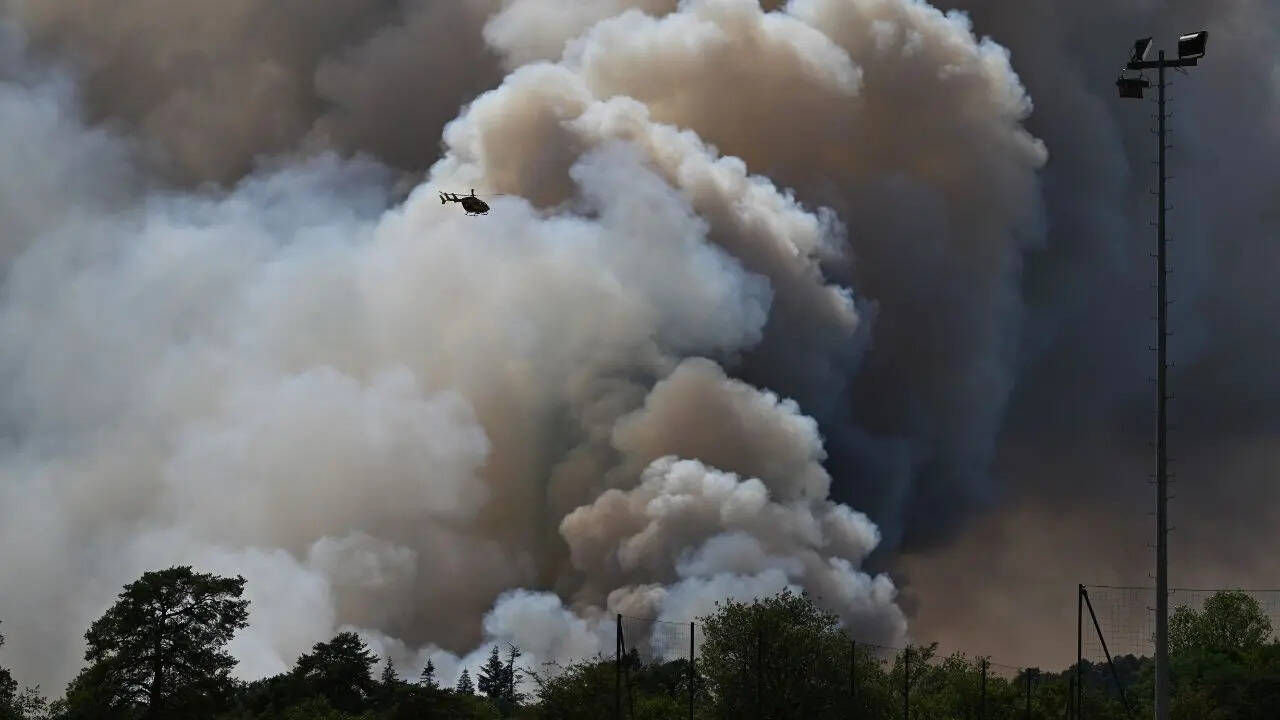
A fast-moving brush fire is burning near Newhall Pass in Santa Clarita right now, and it's already threatening homes and an elementary school in the area, according to early reports. The fire — being called the Tasha Fire — broke out in the Newhall area, with cause unknown at this time.

CBS News and KTLA are both on the story, reporting the blaze is actively burning near residential neighborhoods. The proximity to an elementary school has raised the stakes considerably for local families. No word yet on evacuations, injuries, or how many acres have burned — details are still coming in.

This is a developing story. Information is changing fast, and what we know right now is limited. Stay close to local emergency alerts and follow Santa Clarita Valley Signal, CBS News, and KTLA for updates.

What We Know So Far

Newhall Pass area, Santa Clarita
Newhall Pass area, Santa ClaritaPhoto: mercurynews.com

The fire is burning in the Newhall area, near the Newhall Pass. Homes and at least one elementary school are in the fire's path, per early reports. The cause has not been determined. No official numbers on acreage or containment have been released as of this report.

What We Don't Know Yet

Brush fire, California
Brush fire, CaliforniaPhoto: timesnownews.com

Evacuation orders or warnings, if any, haven't been confirmed in the headlines available. Injuries and structures lost — if any — have not been reported. We don't yet know which elementary school is involved or how close flames have gotten to it.

Stay Safe, Santa Clarita

If you're in the Newhall area, monitor your local emergency alerts and be ready to move. Check LACoFD and the Santa Clarita Sheriff's Station social channels for real-time updates. This story is developing and details may change.

A wildfire is burning near Wildwood Canyon Road in Burbank right now, and evacuation updates are actively coming in, according to early reports. The blaze — being tracked as the Walnut Fire — has prompted officials to push out guidance for nearby residents, so if you're in the area, stay alert and keep an eye on official City of Burbank channels.

The City of Burbank has acknowledged the fire, though full details on size, containment, and the exact scope of evacuations are still coming in. This is a fast-moving situation and conditions can change quickly.

If you're in Burbank and unsure whether your neighborhood is affected, don't wait — check the City of Burbank's official site and local emergency alerts immediately.

What We Know So Far

The fire is burning in the Wildwood Canyon Road area of Burbank. Evacuation updates are ongoing, per early reports from the Hindustan Times and City of Burbank. The cause and acreage have not been confirmed in available reports at this time.

What to Do If You're Nearby

Residents near Wildwood Canyon Road should monitor official City of Burbank emergency pages and local TV for zone-specific evacuation orders or warnings. If you've been told to go, go now — don't wait for more information.

This Story Is Developing

CAL WIRE is monitoring this story as it unfolds. Details including fire size, cause, and confirmed evacuation zones may change. Check back for updates.

HEAT ADVISORY — Northeastern Interior Humboldt
Heat Advisory issued August 8 at 12:23AM PDT until August 8 at 11:00PM PDT by NWS Eureka CA
HEAT ADVISORY — San Diego County Inland Valleys
Heat Advisory issued August 8 at 4:56AM PDT until August 9 at 8:00PM PDT by NWS San Diego CA
HEAT ADVISORY — Santa Ana Mountains and Foothills
Heat Advisory issued August 8 at 4:56AM PDT until August 9 at 8:00PM PDT by NWS San Diego CA
HEAT ADVISORY — Southwestern Interior Mendocino
Heat Advisory issued August 8 at 12:23AM PDT until August 9 at 10:00PM PDT by NWS Eureka CA
HEAT ADVISORY — Southern Salinas Valley/Arroyo Seco and Lake San Antonio
Heat Advisory issued August 7 at 10:06AM PDT until August 9 at 10:00PM PDT by NWS San Francisco CA
HEAT ADVISORY — Sonoma Coastal Range
Heat Advisory issued August 7 at 10:06AM PDT until August 9 at 10:00PM PDT by NWS San Francisco CA
HEAT ADVISORY — Santa Clarita Valley
Heat Advisory issued August 7 at 9:11AM PDT until August 9 at 8:00PM PDT by NWS Los Angeles/Oxnard CA
HEAT ADVISORY — South Central Siskiyou County
Heat Advisory issued August 8 at 5:16AM PDT until August 8 at 11:00PM PDT by NWS Medford OR
HEAT ADVISORY — Western Siskiyou County
Heat Advisory issued August 8 at 5:16AM PDT until August 8 at 11:00PM PDT by NWS Medford OR
HEAT ADVISORY — San Bernardino and Riverside County Valleys-The Inland Empire
Heat Advisory issued August 8 at 4:56AM PDT until August 9 at 8:00PM PDT by NWS San Diego CA
EXTREME HEAT WARNING — Apple and Lucerne Valleys
Extreme Heat Warning issued August 8 at 4:56AM PDT until August 9 at 8:00PM PDT by NWS San Diego CA
HEAT ADVISORY — Riverside County Mountains
Heat Advisory issued August 8 at 4:56AM PDT until August 9 at 8:00PM PDT by NWS San Diego CA
EXTREME HEAT WARNING — Coachella Valley
Extreme Heat Warning issued August 8 at 4:56AM PDT until August 9 at 8:00PM PDT by NWS San Diego CA
HEAT ADVISORY — San Diego County Mountains
Heat Advisory issued August 8 at 4:56AM PDT until August 9 at 8:00PM PDT by NWS San Diego CA
HEAT ADVISORY — San Bernardino County Mountains
Heat Advisory issued August 8 at 4:56AM PDT until August 9 at 8:00PM PDT by NWS San Diego CA
ENTERTAINMENT >
The Hollywood Hills.
The Hollywood Hills.Photo: monocle.com

There's a moment in almost every great action sequence where your brain tells you what you're watching is impossible. A car flips clean over a median on the 101. A body falls six stories and lands wrong. A building swallows a man in fire. You hold your breath. You don't think about the person who actually did that for real, on a Tuesday, for a day rate, then went home and iced their knee.

Hollywood has spent a century perfecting the art of making you forget those people exist. And for most of that century, the industry has rewarded that invisibility with exactly nothing. No Oscar category. No guaranteed credit. No union-negotiated billing. Just the bruises, the risk, and if you're lucky, a thank-you in the EPK nobody watches.

That's finally starting to crack. Slowly, stubbornly, and not without a fight — which, given the people involved, should surprise absolutely no one.

The Work Nobody Credits

The Dolby Theatre in Hollywood, home of the Academy Awards.
The Dolby Theatre in Hollywood, home of the Academy Awards.Photo: yahoo.com

California is where the stunt industry lives. The overwhelming majority of the country's working stunt performers are based in Los Angeles, most of them clustered in the Valley, in Burbank, in the shadow of the same studios that have relied on them since the silent era. Yakima Canutt was doubling John Wayne before talkies were even standard. Dar Robinson was dropping off skyscrapers in the 1970s and '80s. The craft is genuinely old, genuinely dangerous, and genuinely Californian.

The Stunt Performers Guild, the Stunt Coordinators Council, and the larger union apparatus under SAG-AFTRA have spent decades pushing for recognition that actually shows up on screen. What they've gotten, mostly, is polite applause during panel discussions and a persistent industry argument that adding a stunt category to the Oscars would open a can of worms around every other below-the-line craft that deserves one too.

Which is a real argument. It's also one the Academy has been making since at least 1991, when the push for a dedicated stunt Oscar first got serious traction. Thirty-plus years later, the can remains firmly on the shelf.

What the Job Actually Costs

Ask any working stunt performer what they make and they'll tell you two things: that it's better than most people think, and that it doesn't come close to covering what the job takes from your body over a career. Day rates on a studio feature can run several hundred dollars into the low thousands, higher for specialty work. Stunt coordinators, who design the sequences and manage the safety of everyone on set, earn considerably more. But stunt work is freelance, feast-or-famine, and physically cumulative in a way that office jobs simply aren't.

Injuries are a given. Not always catastrophic ones, but chronic damage to knees, shoulders, and spines is so common in the community that veteran performers treat it like weather. You dress for it. You plan around it. You retire before your body stops being insurable.

The deaths, when they happen, hit the whole industry hard. "Deadpool & Wolverine" stunt performer Ryan Hare survived. But the community never entirely forgets the ones who didn't make it. The 2017 death of stunt performer John Bernecker on the set of "The Walking Dead" in Georgia led to safety reviews industry-wide. The fact that it happened at all, on a professional set with experienced coordinators, is the kind of thing that underscores exactly how real the margins are.

The Oscar Fight That Won't Die

Every few years the conversation resets. A blockbuster comes out that's obviously built on stunt work — the "John Wick" franchise being the most recent and obvious case — and the discourse fires back up. Tom Cruise hangs off the side of a plane for "Mission: Impossible." "Mad Max: Fury Road" wins six Oscars, none of them for the jaw-dropping, practical, actually-dangerous vehicular carnage that made it the film it was.

The performers who did that work watched from the audience.

Advocates have proposed a few different frameworks over the years: a dedicated competitive category, an honorary award presented during the main telecast rather than buried in a governors ceremony, or at minimum a guaranteed screen credit tied to union contracts. None have fully cleared the Academy's board, though support inside the membership has grown noticeably as action films have come to dominate the box office and younger voters have pushed for reform.

The argument for a category is simple: if cinematographers, editors, and composers get competitive recognition for their craft, and stunt performers routinely create the most viscerally memorable sequences in the films being nominated for Best Picture, the omission is hard to defend on merit. The argument against it tends to collapse into procedural concerns that, after three decades, are starting to sound less like reasons and more like excuses.

The Coordinators Running the Room

What most civilians don't understand about modern stunt work is how collaborative and technical it's become. A stunt coordinator on a major production is part choreographer, part physicist, part risk manager. They work with directors and cinematographers months before shooting starts. They know which angles hide the wires, which surfaces behave correctly under a fall, and how many times a performer can safely repeat a high-impact gag before the cumulative stress becomes dangerous.

The best of them, names like Chad Stahelski and Spiro Razatos, have built careers so distinguished that the industry has started crediting them in ways it used to reserve only for directors and producers. Stahelski, who doubled Keanu Reeves for years before directing all four "John Wick" films, is the clearest example of how the path from stunt performer to credited filmmaker runs directly through Los Angeles — through the gym, the rigging loft, and the parking lot where you rehearse a car gag at 6 a.m. before anyone official is watching.

Where This Goes Next

The momentum, for once, feels real. The most recent push for an Academy stunt category drew vocal support from directors and A-list actors who, for the first time, seemed willing to say publicly that the omission embarrasses them personally. Studios, mindful that their biggest IP-driven franchises run entirely on practical stunt work that audiences trust more than pure CGI, have started making more noise about it too.

California's stunt community isn't holding its breath exactly. These performers have learned the hard way that enthusiasm in a Variety piece rarely translates to a seat at the table. But the table is closer than it's ever been, and the people who've been doing the impossible on camera since 1915 are still very much in the room.

They're just usually on fire when they get there.

Welcome to California. Five to six million of you are descending on the Golden State for the FIFA World Cup 2026, which means five to six million people are about to have their first real interaction with how American cities actually work versus how they look on TV. You flew in from São Paulo, Buenos Aires, Lagos, Seoul, London, or wherever else, and you are standing at baggage claim at LAX or SFO with a tournament ticket in your pocket and absolutely no idea what you are walking into.

This is not a pamphlet from the tourism board. This is California as it actually exists — magnificent, strange, occasionally chaotic, and completely manageable if you know a few things going in. Consider this your unofficial field guide from the locals who live here year-round and would like you to have a good time and go home safely.

The Venues: What You're Actually Dealing With

California is hosting matches at two venues. SoFi Stadium in Inglewood — now operating as "Los Angeles Stadium" for the duration of the tournament — is hosting eight matches including the USA vs. Paraguay opener on June 12th, a quarter-final, and several knockout-round games. Levi's Stadium in Santa Clara, in the heart of Silicon Valley about 45 miles south of San Francisco, is hosting six matches with the first on June 13th.

These are not downtown venues. SoFi is in Inglewood, adjacent to LAX. Levi's is in Santa Clara, not in San Francisco itself. This matters enormously for your planning. People who assume they can walk out of their downtown San Francisco hotel and stroll to a match are going to be very surprised when they look at the map. Same for anyone who books a hotel in Hollywood thinking SoFi is nearby. Plan accordingly — or prepare for an expensive Lyft with surge pricing during a 70,000-person exit.

Field Tip #1 — Transit is the play, not driving. Metro offers direct service to SoFi for $1.75 each way. The Valley Transportation Authority offers light rail and shuttles to Levi's. Both systems are running expanded World Cup service. Use them. The alternative is sitting in traffic while your country's team wins without you.

Los Angeles: The Lay of the Land

Los Angeles is not one city. It is 88 incorporated cities and dozens of unincorporated communities spread across an area roughly the size of Rhode Island, connected by a freeway system that functions as both infrastructure and emotional crisis. Understanding this upfront will spare you considerable confusion.

The neighborhoods you want to be in as a tourist — Santa Monica, Venice Beach, West Hollywood, Silver Lake, Koreatown, Downtown, Hollywood, Culver City, Marina del Rey — are all genuinely enjoyable, well-patrolled, and built around the assumption that visitors exist. These areas have excellent restaurants, bars, transit access, and the kind of energy that makes LA worth visiting. SoFi's immediate surroundings include Market Street in Inglewood, which local guides recommend for pre-match dining and atmosphere.

The practical safety guidance that every legitimate travel publication agrees on: stay in well-lit areas after dark, be aware of your surroundings in neighborhoods you don't know, don't wander alone late at night into residential areas far from the main tourist corridors, and keep your phone out of sight on public transit. Downtown LA specifically — while worth visiting during the day for the architecture, Grand Central Market, and the Arts District — borders the Skid Row area, which has a significant unhoused population and is not somewhere to be wandering late at night unfamiliar with the geography.

The honest truth about LA crime for World Cup visitors: the areas that generate the most serious crime statistics are residential neighborhoods that tourists have essentially no reason to visit. Watts, South Central, parts of East LA — these are communities where real people live and where crime rates are elevated by poverty and historical underinvestment, not places that appear on any tourist itinerary. You would have to work hard to end up in them by accident.

Field Tip #2 — The LA taxi scam. Unlicensed taxi drivers at LAX are a decades-old tradition of separating confused tourists from their money. Use the Rideshare app pickup zones (Level 1, lower level) for Uber and Lyft, or the official taxi stands. Anyone approaching you in the arrivals hall offering a ride is not the move.

The Bay Area: A Different Kind of City

San Francisco is one of the most beautiful cities in the United States and one of the most visually jarring for first-time visitors. The combination of Victorian architecture, world-class restaurants, dramatic hills, and a severe housing and homelessness crisis makes for an experience that requires some mental calibration. The Tenderloin neighborhood — centrally located, right next to the theater district — has been a challenging area for decades and remains so. The areas around Civic Center and parts of SOMA (South of Market) can feel disorienting after dark.

The tourist areas of San Francisco — Fisherman's Wharf, the Ferry Building, Union Square, Chinatown, North Beach, the Mission, the Castro, Pacific Heights, and the neighborhoods along the waterfront — are excellent, well-maintained, and where you should be spending your time anyway. The city's BART system is the main transit artery connecting San Francisco, Oakland, Berkeley, and Silicon Valley. BART runs directly to the Millbrae station, from which a short Caltrain or VTA ride gets you to Levi's Stadium in Santa Clara.

One practical note for the Bay Area: car break-ins have historically been a persistent nuisance, particularly in tourist areas and parking lots. Leave nothing visible in your rental car. Nothing. Not a bag, not a jacket, not an empty water bottle that might make someone think there's a bag underneath it. This is not an exaggeration — it is the single most repeated piece of local advice given to visitors by Bay Area residents.

Field Tip #3 — The "friendly stranger" pattern. In crowded tourist areas across California, be alert to the distraction scam: someone engages you in friendly conversation while an accomplice goes through your bag or pockets. This is not California-specific — it happens at every major sporting event in every major city worldwide. Just be aware.

Listen. We don't normally cover NASCAR here. But when you race cars around a Navy base in Coronado, throw in the Kelce brothers, Patrick Mahomes, Marshawn Lynch in full Beast Mode, Scott Eastwood looking like he walked off a movie set, Drew Brees waving a green flag, and oh by the way the whole thing doubles as Travis Kelce's bachelor party — yeah, we're covering it.

San Diego just had one of the most surreal weekends in recent Southern California sports history and nobody is talking about it enough. Let's fix that.

The Race: Kid From Georgia Stuns the Field

The actual race — the Anduril 250, held Sunday June 21st on a 3.4-mile, 16-turn temporary street course built on Naval Base Coronado — was legitimately wild. Corey Heim, a 23-year-old part-time driver making just his 13th career Cup Series start, outdueled 23XI Racing teammate Tyler Reddick in the closing laps to claim his first career victory. This kid hit the wall twice early, dropped back to 20th, and still won the race. Absolute cinema.

Reddick slipped in Turn 2 with three laps to go, giving Heim the opening he needed. The teammates ran side-by-side, Reddick tried a crossover move and made contact, then ceded the position — and later suffered a flat tire that dropped him to 25th. Points leader Reddick needed a good day. Did not get one.

Bubba Wallace finished second, giving 23XI Racing — the team co-owned by NBA legend Michael Jordan — its first ever 1-2 finish in the Cup Series. Kyle Larson was third. Seven-time champion Jimmie Johnson, in his second and last Cup start of the year, slammed a tire barrier on lap five and finished 28th. Even legends have bad days.

It's the second time in three years that an inaugural NASCAR street race produced a first-time winner — Shane van Gisbergen did the same thing at the 2023 Chicago Street Race. Street courses just break the game differently.

The Celebrity Circus: San Diego Became an A-List Party

Forget the race for a second. The guest list at Naval Base Coronado this weekend read like the invite list to the Met Gala if the Met Gala was sponsored by racing fuel and American flags.

Travis and Jason Kelce, Patrick Mahomes, Drew Brees, Trevor Hoffman, Scott Eastwood, and Marshawn Lynch all attended. That's two future Hall of Fame quarterbacks, one of the greatest closers in baseball history, a Hollywood actor, and Marshawn Lynch walking around a Navy base. Completely normal Sunday in San Diego.

Patrick Mahomes spent part of the weekend at Kyle Larson's No. 5 Hendrick Motorsports pit. The two swapped uniforms last year. Mahomes in a fire suit is a look. Drew Brees served as Grand Marshal for Saturday's race and gave the command for drivers to start their engines. San Diego Padres legend Trevor Hoffman rode in the pace car. Scott Eastwood got on stage AND reportedly got a ride in an actual race car. Of course he did.

And Marshawn Lynch walked onstage during pre-race ceremonies and was simply himself, which is always more than enough. Beast Mode forever.

Travis Kelce's Bachelor Party: San Diego Edition

Travis Kelce didn't just show up to the race. He showed up as the centerpiece of what has become the most well-documented bachelor party in NFL history.

The week started Wednesday June 17th in Los Angeles — Kelce hit the Bird Streets Club on the Sunset Strip in West Hollywood with pals including former Chiefs teammate Ross Travis, comedian Druski, and brother Jason. Then Friday, the group hit a Chris Lake concert in LA, with Travis getting up on stage to shoot a bubble gun into the crowd.

Then Sunday — NASCAR in Coronado with Mahomes and Jason. And then, because one major event wasn't enough, TMZ obtained video of Travis and Jason Kelce leaving Viejas Arena at SDSU after Dave Chappelle performed an hour-and-a-half set. The brothers were seen boarding a party bus with about eight very athletic-looking dudes. Travis and Jason shared a big hug in the parking lot before Travis climbed onto the bus. Someone screamed "Love you, Travis!" from the crowd. We don't blame them.

And then there was the cake — an LA bakery shared video of what they described as Kelce's bachelor party cake. A colorful tie-dye creation with the words "One More Ring" across the top. As in Super Bowl ring AND wedding ring. That's either the most confident thing ever committed to frosting or proof that this man simply cannot be stopped.

The Wedding: Madison Square Garden, July 3rd

While Travis was living his best life in San Diego, Taylor Swift was apparently doing the same on the opposite coast. A bunch of Swift's friends showed up at her Rhode Island mansion this weekend — bachelorette party speculation went through the roof. A massive fireworks display went off near her Watch Hill estate, which is either a bachelorette party or Taylor Swift being Taylor Swift. Probably both.

The wedding location is no longer a secret. A city official confirmed that Madison Square Garden is hosting the festivities on July 3rd. A permit was filed to close streets around MSG from July 2nd to midday July 4th. The reception is expected to draw up to 1,000 guests. Chiefs coach Andy Reid confirmed he's attending. Mahomes and Brittany are in. The Kittles are in. Half the Kansas City Chiefs have apparently booked rooms at the Marriott Marquis in Times Square for around July 3rd.

To recap: Travis Kelce spent last weekend watching cars race around a Navy base, going to a Dave Chappelle show on a party bus, eating a tie-dye cake that said "One More Ring" — and in nine days he'll marry the biggest pop star on earth at Madison Square Garden. This man is living a life that should not be statistically possible. And San Diego got a front-row seat.

After years of runaway production — studios fleeing to Georgia, New Mexico, Canada, and the UK for cheaper tax credits — something is shifting in Hollywood. California is fighting back, and some of the biggest names in the business are responding.

The state expanded its film and television tax credit program significantly in 2025, raising the annual cap and broadening eligibility to attract more big-budget productions back to Los Angeles. The results are starting to show. Universal, Warner Bros., and Disney have all announced major productions returning to California lots and LA locations for 2026 and 2027. The Fast and Furious finale — Fast 11, set for April 2027 — will film extensively in Los Angeles, with Vin Diesel specifically citing a desire to bring the franchise home after years of shooting abroad.

The LA Fires and the Industry That Survived Them

It would be impossible to talk about Hollywood in 2026 without acknowledging January 2025, when the most destructive wildfires in Los Angeles history tore through Pacific Palisades, Altadena, and surrounding communities. Hundreds of industry workers lost their homes. Production facilities were threatened. The psychological toll on a city already exhausted from years of pandemic, strikes, and economic uncertainty was immense.

But Hollywood didn't leave. If anything, the fires accelerated a sense of community and recommitment to the city. Benefit concerts, industry fundraisers, and studio employee relief funds raised hundreds of millions of dollars for displaced workers and residents. Productions that had been considering out-of-state moves reconsidered. There is something about a crisis that clarifies what actually matters — and what matters to the film industry, it turns out, is Los Angeles.

Streaming Wars: California's Quiet Dominance

Netflix, Amazon, Apple, and Disney+ are all headquartered in California. The streaming era, for all its disruption to traditional Hollywood economics, has been enormously good for the state's creative economy. California-based streamers collectively employ tens of thousands of writers, directors, actors, crew members, and support staff, and the production volume required to feed streaming platforms has kept soundstages and post-production houses busier than they've ever been.

The 2023 writers and actors strikes — which shut down Hollywood for most of that year — won significant protections around AI use in productions and improved residual structures for streaming content. Those deals, negotiated by California-based unions, set the standard for the entire industry nationwide.

Music: California Still Runs It

Los Angeles remains the undisputed capital of the American music industry. The Recording Academy is based here. The Grammy Awards are held here. Coachella, now in its third decade, draws 125,000 people per weekend to the desert east of LA and generates hundreds of millions in economic activity for the Inland Empire and the Coachella Valley every April.

The live music economy in California bounced back dramatically from the pandemic, and venues from the Hollywood Bowl to the Kia Forum to Chase Center in San Francisco are selling out consistently. California artists continue to dominate pop, hip-hop, Latin music, and country — yes, country, with Kern County and Bakersfield maintaining a legitimate claim to the genre's roots that Nashville doesn't like to talk about.

What's Coming

The back half of 2026 is shaping up to be a big one for California entertainment. Fast 11 is in production. Several major Marvel projects are filming in LA. Award season buzz is already building around California-set films from major directors. And the FIFA World Cup, playing out across American cities this summer, has Los Angeles hosting multiple matches at SoFi Stadium — giving the entertainment infrastructure here a global stage it rarely gets outside of the Oscars.

Hollywood has been declared dead so many times it's become a cliché. Every year somebody writes the obituary. Every year the lights on the lots stay on. California's entertainment industry is not dying. It's adapting — and it's still the center of the world.

#Aug 28-30 Aug 28-30 [NEW]
Weekend: N/A (-)
- theaters · wk - · 35
#Aug 21-23 Aug 21-23 [NEW]
Weekend: N/A (-)
- theaters · wk - · 34
#Aug 7-9 Aug 7-9 [NEW]
Weekend: N/A (-)
- theaters · wk - · 32
#Jul 31-Aug 2 Jul 31-Aug 2
Weekend: $429,572,594 (+192.9%)
25 theaters · wk - · 31
#Jul 24-26 Jul 24-26
Weekend: $146,638,349 (-22.1%)
55 theaters · wk - · 30
#Jul 17-19 Jul 17-19
Weekend: $188,274,749 (+47.2%)
50 theaters · wk - · 29
#Jul 10-12 Jul 10-12
Weekend: $127,921,760 (+7.5%)
64 theaters · wk - · 28
#Jul 3-5 Jul 3-5
Weekend: $118,985,670 (-23.8%)
58 theaters · wk - · 27
#Jun 26-28 Jun 26-28
Weekend: $156,250,719 (-32.6%)
65 theaters · wk - · 26
#Jun 19-21 Jun 19-21
Weekend: $231,685,897 (+85%)
62 theaters · wk - · 25
SPORTS >

Let's just get it out of the way: the Los Angeles Dodgers are, once again, the most dangerous team in baseball. Back-to-back World Series champions. The richest roster in the sport. And at the center of it all, the most extraordinary player anyone has ever seen wear a uniform.

The question for 2026 isn't whether the Dodgers are good. It's whether they can do something only a handful of teams in baseball history have done: win three in a row.

Shohei Ohtani: Still Breaking Baseball

There is no adequate way to write about Shohei Ohtani without sounding like you're making things up. In 2025 alone, the man won NL MVP, led all of baseball in runs scored and total bases, led the NL in slugging percentage and OPS, won the NLCS MVP by hitting three home runs AND pitching six scoreless innings with ten strikeouts in the same game, and then terrorized the Toronto Blue Jays in the World Series so thoroughly that they resorted to intentionally walking him to keep him off the bases. He reached base nine times in a single postseason game — tying the record.

He is now 31 years old. He has a second child on the way. He is, if anything, getting better.

This season, the Dodgers have added outfielder Kyle Tucker and closer Edwin Díaz to an already loaded roster. Projection systems have them pegged at over 100 wins. Starting pitching injuries — to Tyler Glasnow, Blake Snell, Gavin Stone, and Landon Knack — have slowed them in the early going, but even a depleted Dodgers rotation is better than most full ones. As of this writing they are at 32-20, in first place in the NL West, with Ohtani doing Ohtani things.

The last team to win three straight World Series was the 2000 New York Yankees. The Dodgers have the talent, the depth, the front office, and the financial muscle to make a real run at it. What they need is health — and a little bit of October luck.

The Padres: Still Dangerous, But the Window Is Narrowing

Give San Diego credit: they keep punching. The Padres have made the playoffs in four of the last five seasons under a franchise that previously only made it five times in 52 years. Fernando Tatis Jr. and Manny Machado remain two of the best players in the National League. Jackson Merrill is a star. The bullpen is deep.

But the Padres are starting to show their age and their limits. They lost Dylan Cease in the offseason. Walker Buehler has been inconsistent. Blake Snell — now on their roster — has spent more time on the injured list than on the mound. Under first-year manager Craig Stammen, they're scrapping and fighting, sitting near .500 early in the season, holding on to a wild card spot mostly on talent and grit rather than depth.

The uncomfortable truth is that the Padres are a team without a World Series title in their entire franchise history, and the margin for error to get there is shrinking every year. Tatis and Machado aren't getting younger. The prospect pipeline isn't overflowing. This could still be a very good San Diego season. But the ceiling feels lower than it did a few years ago.

The Giants: Four Years of Hovering Around .500 and Counting

Here is a stat that should embarrass the San Francisco front office: the Giants have finished between 79 and 81 wins in four consecutive seasons. Not bad enough to get a top draft pick. Not good enough to compete. Just... there. Logan Webb is still one of the best starting pitchers in baseball, leading the majors in innings last year with 207. But the Giants lost Hayden Birdsong to Tommy John surgery for the entire 2026 season, and their offense has been average at best.

New manager Bob Apodaca comes to San Francisco straight from the University of Tennessee, which is an unusual hire for a major league club. Top prospect Bryce Eldridge — a massive first baseman with genuine power — is in the minor leagues getting reps. The Giants need him to be ready, and soon, because right now this team does not have a clear path to anything beyond another .500 season.

The NL West is, as it has been for years, the Dodgers and everyone else. The Padres will fight for a wild card. The Giants will try to avoid embarrassment. And Shohei Ohtani will continue to do things that make you stop what you're doing and just stare at the screen.

Three-peat? It's possible. Don't bet against them.

MLB
5:00 PM PT — Giants @ Rangers [AWAY] (Globe Life Field) — Watch: ESPN
5:05 PM PT — Dodgers @ Cubs [AWAY] (Wrigley Field) — Watch: MLB.TV, SportsNet LA, Marquee Sports Net
6:40 PM PT — Padres @ Diamondbacks [AWAY] (Chase Field) — Watch: MLB.TV, Padres.TV, DBACKS.TV
No California sports headlines today.
MLB
12:15 PM PT — Brewers @ Angels (Angel Stadium) — Watch: Peacock
1:05 PM PT — Tigers @ Athletics (Sutter Health Park) — Watch: MLB.TV, Tigers.TV, NBC Sports CA
1:10 PM PT — Giants @ Padres (Petco Park) — Watch: MLB.TV, NBC Sports BA, Padres.TV
4:20 PM PT — Red Sox @ Dodgers (Dodger Stadium) — Watch: NBC, Peacock
No California sports headlines today.
CULTURE >
LAPD headquarters, Los Angeles.
LAPD headquarters, Los Angeles.Photo: dailynews.com

Only in Los Angeles can a cop do everything right and still end up the one facing charges. An LAPD officer recorded colleagues making racist remarks, handed over the evidence, and apparently expected that to be the end of it. Instead, Los Angeles County District Attorney Nathan Hochman's office turned around and filed charges against the officer who made the recording. The colleagues on tape? Still waiting to hear their fate, apparently.

The story broke this week and the backlash was immediate and loud. Civil rights advocates, defense attorneys, and more than a few LAPD officers themselves are asking the same question: what exactly is the message here? Record your coworkers being racist, get prosecuted. It's the kind of outcome that feels like a punch line, except nobody's laughing.

This one matters well beyond the LAPD parking lot or break room or wherever those remarks were captured. California has been locked in a years-long argument about police accountability, department culture, and what happens to officers who try to expose it. This case just landed in the middle of all of it, lit on fire.

What We Know So Far

Details remain thin, as they tend to be when a D.A.'s office is taking heat and staying quiet. What's confirmed, according to wire reports, is that an LAPD officer recorded fellow officers making racist remarks and that Hochman's office filed charges against that recording officer. The specific charge hasn't been widely reported yet, but California's two-party consent law, Penal Code 632, makes it a crime to record a confidential conversation without all parties' knowledge. That's likely the hook prosecutors are using.

Hochman, a Republican who flipped the D.A.'s seat from progressive incumbent George Gascón in November, ran on a tough-on-crime platform. Filing charges against a cop who exposed racist colleagues is a sharp detour from that brand, and critics are noting the irony loudly. The officer's attorney hasn't made a public statement that's been widely circulated yet, but the legal community is already gaming out the free-speech and public-interest defenses.

The LAPD itself has not publicly backed its officer. That silence is its own statement.

The Law That Cuts Both Ways

California State Capitol, Sacramento.
California State Capitol, Sacramento.Photo: asianjournal.com

California's wiretapping statute is no joke. Unlike federal law or the rules in most states, California requires all parties to a private conversation to consent to being recorded. Violating it is a crime, not just a civil matter. Courts have carved out some exceptions over the years, particularly for law enforcement interactions, but workplace recordings among officers in a non-public setting are genuinely murky territory.

The two-party consent rule has been used before to go after people who recorded encounters they later wished they'd kept to themselves. It's also been used, critics argue, to protect powerful institutions from embarrassing exposure. A police officer recording colleagues in a workplace isn't obviously the same as someone secretly taping a private phone call. Whether a D.A. should treat it that way is a different question entirely, and that's the one Hochman now has to answer publicly.

Legal observers note that prosecutors have enormous discretion about which cases they actually take to court. Even if the technical elements of a crime are present, filing charges is a choice. Hochman made that choice knowing full well what the optics would look like. Whether that's principled rule-following or a catastrophic read of the room depends heavily on who you ask.

The Bigger Fight This Plugs Into

Downtown Los Angeles.
Downtown Los Angeles.Photo: businessinsider.com

Los Angeles has been rebuilding its relationship with reform-minded policing since the federal consent decree days. That process has never been clean or linear, and the LAPD's internal culture has never been easy to crack open. Officers who flag misconduct by colleagues routinely describe the aftermath as career-ending. That's not a California-specific problem, but California is where the law, the politics, and the demographics make the stakes highest.

Hochman beat Gascón by running against the perception that progressive prosecutors let criminals off the hook. But charging a cop for recording racist coworkers doesn't fit neatly into either camp's talking points. Conservatives who back the blue are uncomfortable. Progressives who want accountability are furious. The civil liberties crowd is horrified. It's a rare move that manages to alienate virtually everyone at once.

State Assemblymember Reggie Jones-Sawyer, who has pushed hard on police accountability legislation, hadn't issued a formal response as of press time. But the California Legislative Black Caucus has historically moved fast when cases like this surface in LA, and this one is the kind that tends to produce press conferences within days.

What Happens Next

The officer will almost certainly mount an aggressive public interest defense, arguing the recording served to expose misconduct, not invade a reasonable expectation of privacy. California courts have shown some appetite for that argument in prior cases involving whistleblowers, though not always in a law enforcement context specifically.

Hochman's office will face sustained pressure to explain whether the racist officers captured on that recording face any charges of their own. If they don't, the disparity in treatment is going to be the story for as long as this case is alive. That could be a very long time.

The LAPD's command staff would be wise to say something before someone in Sacramento says something for them.

In a city that spent the better part of two decades fighting to reform its police department from the outside, charging the officer who handed reformers the evidence is one way to remind everyone just how far there is still to go.

Los Angeles was built for the car. The freeways, the drive-ins, the endless sprawl — this city has always had a relationship with the automobile unlike anywhere else on earth. And out of that relationship came something genuinely beautiful: a car culture rooted in craft, community, and pride that became one of the defining art forms of the American Southwest.

Lowriders: Art on Wheels

Lowriding was born in the barrios of East Los Angeles in the 1940s and 50s, when Mexican-American car enthusiasts began modifying their vehicles to ride as low as possible — a deliberate rejection of the "high and fast" mainstream car culture of the time. These weren't just cars. They were moving canvases: candy paint jobs in colors that had no names, hand-stitched velvet interiors, hydraulic systems that could make a car bounce and dance on command. The workmanship was extraordinary — some of these builds took years.

Lowriding was cultural expression. It was a Chicano art movement that happened to use steel and chrome instead of paint and canvas. Car clubs like the Imperials and the Dukes became community institutions, organizing shows, charity drives, and family events. The lowrider became a symbol of Chicano identity and pride that spread from LA to every major American city with a Latino community.

The Fast and the Furious: Hollywood Pours Gasoline on the Fire

In 2001, a small movie set in the streets of Los Angeles changed everything. The Fast and the Furious cost $38 million to make and grossed over $200 million worldwide. It was shot on the actual streets of LA — Crenshaw, the 10 freeway, the Terminal Island Drag Strip — and it made underground street racing look like the coolest thing a person could possibly do.

It was fiction, of course. But it didn't play that way to a generation of young men who grew up watching it. The movie sparked a real-world street racing boom across Southern California. LAPD tracked spikes in street racing calls every time a new installment hit theaters. The franchise has now produced eleven films and is preparing a twelfth — Fast 11 — set to return to LA streets and release in April 2027. Vin Diesel himself announced it would go back to the franchise's roots: street racing in Los Angeles. Law enforcement is already bracing.

The original film tapped into something real. The underground street racing scene in LA was already thriving before the movie came out — drag races on the 101, meets in empty industrial parking lots in Gardena and Compton. Fast and Furious didn't create car culture in LA. It just turned a spotlight on it and handed it a megaphone.

Street Takeovers: When Culture Becomes Chaos

Here's where it gets complicated. The same impulse that created lowrider shows and drag nights — the desire to show off, to perform, to belong — has evolved into something that is genuinely endangering lives.

Street takeovers are what happens when a group of cars — sometimes dozens, sometimes hundreds — roll up to an intersection, block it in all directions, and use it for donuts, drifting, and stunts while spectators watch. They are illegal. They are dangerous. And they have become a serious problem across Los Angeles and Southern California.

USC's Open-Source Intelligence Lab reviewed over 500 social media videos of LA-area takeovers between 2020 and 2025. They found 48 videos showing people being struck by vehicles. Fourteen of those involved someone being run over. Fires. Laser pointers aimed at drivers. Cars set ablaze. At a takeover in Compton, two spectators — 22-year-old Juan Antonio Orozco and 19-year-old Javier Carachure Menchaca — were shot and killed. On Christmas 2022, 24-year-old Elyzza Guajaca was watching a takeover at Crenshaw and Florence when a Camaro struck and killed her.

This is not car culture. This is chaos wearing car culture's clothes. And it's doing real damage to the community that built the actual thing.

A Way Forward

The people who love legitimate car culture — the lowrider builders, the track racers, the car club members who've been doing this right for decades — are as frustrated as anyone. They didn't build this scene to watch it become a liability.

LA County released a Street Takeover Action Plan in early 2025, focusing on infrastructure barriers at hotspot intersections, stronger enforcement, and — critically — the development of legal alternatives. That last part is the key. The demand for this kind of spectacle isn't going away. The question is whether the city can channel it somewhere that doesn't kill people.

The solution isn't just more police. It's sanctioned events. Legal car meets at fairgrounds and tracks. Organized drift days. Pop-up shows in closed parking structures with security and structure. Some cities have already made this work. San Diego's car show scene at Petco Park. The NHRA at Auto Club Famoso Raceway. The Roadster Show in Pomona.

California's car culture is one of the most distinctive things about this state. It belongs to communities that put real love, real money, and real craft into it. It deserves better than being run into the ground — literally — at 2am at an intersection in Compton. Give these guys a place to do it right, and most of them will show up.

Police trace last known footsteps of Fairfield woman missing for weeks
SAN FRANCISCO (KRON) -- Chantel Brooks, a 36-year-old Fairfield woman reported as missing, was last seen in the early morning hour... — KRON4
Person riding scooter suffers fatal head trauma at Powell and Market in SF
SAN FRANCISCO (KRON) -- A person riding a scooter died Friday morning after suffering fatal head trauma in the area of Powell and... — KRON4
Salesforce to cut dozens of jobs in San Francisco
SAN FRANCISCO (KRON) -- Salesforce has announced plans to cut dozens of jobs in San Francisco. According to a state filing with th... — KRON4
City of Ukiah makes changes to proposed annexation map
Revised map adds area of Brush Street and removes 15 acres. — Mendo Voice
Man slain in Martinez, police release photo of alleged attacker on the run
(KRON) -- A 68-year-old man is dead after being stabbed in front of a Martinez home on Thursday. Police have released photos of a... — KRON4
Suspected drug dealer faces murder charge in overdose death of Orinda resident
(KRON) -- A suspected drug dealer was charged with murder Thursday in Contra Costa County. Ulzii Orshikh Batsukh, 26, of Alameda,... — KRON4
What new owners have planned for Berkeley’s legendary Fantasy Studios building — Berkeleyside
Why I Can’t Support Sneddon for Mayor — SB Independent
Free Phone Tents Hide Identity Thieves — SB Independent
Heat advisory set for inland Bay Area as temps reach 100s
SAN FRANCISCO (KRON) -- A hot weekend forecast reaches the inland Bay Area with highs in the 90s to 100s. A heat advisory will go... — KRON4
School district loses court challenge of charter school approval — BenitoLink
Commissioners consider lower tax rate
By ALBERT VILLEGASSpecial to the NEWS In planning their upcoming fiscal year budget, the San Benito Commissioners are considering... — San Benito News
Stops lead to arrests
Special to the NEWS Two separate and unrelated arrests by San Benito Police Department (SBPD) officers resulted in the seizure of... — San Benito News
Monrreal sentenced to 35 years
Special to the NEWS BROWNSVILLE, TX—A Los Fresnos man was sentenced to 35 years in state prison after being convicted of murder in... — San Benito News
Martinez set for trial
NEWS Staff Report BROWNSVILLE, TX—The accused killer of veteran San Benito police officer faces trial on Capital Murder and other... — San Benito News
Conjunto fest announced
By ALBERT VILLEGASSpecial to the NEWS Texas Conjunto Music Hall of Fame & Museum officials announced last week that it will ho... — San Benito News
Bay Area air quality ‘may become unhealthy’ due to PNW wildfires
SAN FRANCISCO (KRON) -- An air quality advisory was issued Tuesday for the Bay Area as smoke from wildfires burning in Oregon and... — KRON4
Featured Pet: Cleo
A constant companion, she’s happiest when she’s with her people. Is that you? — Mendo Voice
Bay Area man sentenced for assaulting woman outside 7-Eleven
(KRON) -- A 20-year-old Mountain View man who assaulted and groped a woman outside a 7-Eleven in East Palo Alto in 2025 was senten... — KRON4
BART service suspended between Antioch, Pittsburg stations
(BCN) -- BART service between the Antioch and Pittsburg/Bay Point train stations was suspended Tuesday morning because of an equip... — KRON4
What Berkeley families need to know about Trump Accounts for babies, kids
A law change means California families won’t owe taxes on money in Trump Accounts. Families in two Berkeley zip codes may be eligi... — Berkeleyside
CHP responds to fiery fatal crash in Campbell
(KRON) -- The California Highway Patrol responded to a fatal crash early Tuesday morning in Campbell. The collision occurred aroun... — KRON4
Q&A with incoming Anzar Principal Shamoon Ebrahimi — BenitoLink
AC/DC concert to bring heavy traffic near Levi's Stadium: Here's what you need to know
(KRON) -- Legendary rock band AC/DC is coming to Santa Clara this week, and the traffic is expected to be a "Highway to Hell." The... — KRON4
AI tech companies now selling high-end merch
(KTLA) -- Once upon a time, Silicon Valley was viewed as not the "swaggiest" of places. Basically, you go to an event and maybe ge... — KRON4
Power restored for nearly 5K customers affected by power outage
(KRON) -- A power outage Monday night affected nearly 5,000 PG&E customers in Walnut Creek, according to PG&E's outage map... — KRON4
Man arrested for bar shooting in Santa Rosa
(KRON) -- A man was arrested for shooting a person outside a bar in Santa Rosa, according to the city's police department. The sho... — KRON4
San Francisco Giants clean house at trade deadline
SAN FRANCISCO (KRON) -- It was a busy Monday for the San Francisco Giants just before Major League Baseball's trade deadline as th... — KRON4
Man Allegedly Crushes Occupied Car with Tractor During Argument in Santa Maria — SB Independent
Letter to the Editor: Ukiah City Council ignores its own general plans — and decades of advocacy
Waterways that flow through Ukiah should be protected and enhanced. It’s all part of making Ukiah a walkable city. — Mendo Voice
The Mendocino Setlist: August 3-9, 2026
Your weekly guide to upcoming music events in Mendocino County. — Mendo Voice
South Bay woman's mother remains locked up in ICE facility
(KRON) -- The mother of a Sunnyvale woman who U.S. Immigration and Customs Enforcement (ICE) said overstayed her visa remains behi... — KRON4
6 people displaced by fire in San Francisco
(BCN) -- Six people were displaced after a one-alarm fire damaged a multi-unit residential building in San Francisco's Visitacion... — KRON4
Point Arena: Mendocino County’s tectonic traveler
California’s coastline tip of the spear, the Point Arena peninsula is home to spectacular landforms and rare and endangered plants... — Mendo Voice
Vault fire in San Francisco triggers temporary shelter-in-place
SAN FRANCISCO (KRON) -- San Francisco residents near an underground electrical vault fire in the Upper Haight neighborhood were te... — KRON4
3 killed in crash blocking all lanes of Highway 113
(KRON) -- Three people are dead after a head-on collision on Highway 113 in Solano County. All lanes in both directions are blocke... — KRON4
Woodside Fire is 30% contained, but what does that actually mean?
(KRON) -- The Woodside Fire that ignited Thursday and continues to burn in Sonoma County on Friday was announced as being 30% cont... — KRON4
Where to swim on a hot day in Berkeley
Check out this useful roundup of the city’s pools and swimming holes, plus favorite spots a drive away and tips on where to grab a... — Berkeleyside
Hot, dry Friday in Bay Area
(BCN) -- Friday in the Bay Area calls for hot and dry conditions with mostly sunny skies, especially inland, with cooler temps nea... — KRON4
Tale of two health care directors — BenitoLink
Anthropic says its AI models hacked 3 organizations during testing
Anthropic said its artificial intelligence models hacked into three other organizations during testing, just days after ChatGPT ma... — KRON4
San Sebastian ready for homeowners
By ALBERT VILLEGASSpecial to the NEWS Currently, the San Sebastian subdivision’s landscape has amenities ready for use, integrated... — San Benito News
District head finalist named
Special to the NEWS LOS FRESNOS, TX—The school board of trustees has named Dr. Joseph Villarreal as the lone finalist for Superint... — San Benito News
Trail ride benefit slated
By JACQI LEYVA-HILLSpecial to the NEWS RIO HONDO, TX—A community event featuring a cook-off, a trail ride and other activities is... — San Benito News
Abbott appoints SB’s Perez
Special to the NEWS AUSTIN, TX—Governor Greg Abbott recently appointed three members to the state’s Early Childhood Intervention A... — San Benito News
Williams Road hearings continue
By JACQI LEYVA-HILLSpecial to the NEWS The Texas Department of Transportation (TXDoT), in cooperation with the Cameron County Regi... — San Benito News
Flores named girls’ coach
By ALBERT VILLEGASSpecial to the NEWS RIO HONDO, TX—Raven Flores is now the head coach of arguably the Rio Grande Valley’s b... — San Benito News
COMMENTARY: T-Accounts offer shot at wealth
Joe Martinez, Ed.D., is a Doctor of Curriculum & Technology, a U.S. Military Veteran, and a San Benito native. San Benito is o... — San Benito News
HISTORY >

Drive about two hours north of San Francisco along the rugged Sonoma Coast and you'll find a small wooden stockade perched above the Pacific, flying a flag that hasn't represented a governing power here in nearly two centuries. Fort Ross — the name itself a shortened, Americanized echo of "Rossiya," Russia — is the most visible surviving proof of a chapter in California history that surprises most people who grew up here: for about three decades, the Russian Empire had a foothold on the California coast, and it wasn't a footnote. It was a functioning colonial outpost with farms, a shipyard, an orchard that still produces pears today, and a resident population that included Russians, Alaska Native hunters brought south for their maritime skills, and Native Californians from the local Kashaya Pomo community.

California was never a Russian territory in the way Alaska was. But for a stretch of the early 1800s, the northern reaches of what's now Sonoma County were, in practical terms, Russian ground — governed from a fort, defended by cannon, and run by a chartered company answering to St. Petersburg.

The Fur Trade That Started It All

The story begins not in California but in the North Pacific, where Russian explorers and fur traders had been pushing east across Siberia and Alaska since the 1700s in relentless pursuit of one animal: the sea otter. Otter pelts were extraordinarily dense and valuable, especially in the lucrative Chinese fur trade, and by the early 1800s Russian hunters working under the Russian-American Company — a state-chartered fur trading enterprise not unlike Britain's Hudson's Bay Company — had hunted the Alaskan otter population toward collapse.

Looking for new hunting grounds and, just as importantly, a reliable source of food to supply the chronically undersupplied Alaskan settlements, the Russian-American Company turned its attention south. California's coast was rich in otters, had a much friendlier growing climate than Alaska, and was only nominally defended by a thinly stretched Spanish colonial administration that had far bigger concerns than a few Russian ships anchoring north of San Francisco Bay.

Fast Fact — Fort Ross was built in 1812, the same year the United States went to war with Britain. While Napoleon was marching on Moscow, Russian colonists an ocean and a continent away were breaking ground on a fort roughly 90 miles from where San Francisco's Ferry Building stands today.

Life at Fort Ross

Fort Ross was never a large settlement — population estimates for its peak years run somewhere in the low hundreds — but it was a genuinely diverse and industrious one. Russian company officials and their families lived alongside Alutiiq and Sugpiaq hunters brought down from Alaska specifically for their otter-hunting skill, and the fort depended heavily on labor and trade relationships with the local Kashaya Pomo people, whose descendants still live in the region today and remain involved in the site's preservation and interpretation.

The fort functioned as a working agricultural and industrial outpost. Colonists built California's first windmills, planted the state's first commercial vineyard attempts, ran a shipyard that built ocean-going vessels from local redwood, and maintained an orchard whose original trees — remarkably — are still alive and still bearing fruit, making them among the oldest cultivated fruit trees in California.

Spanish, and later Mexican, authorities were never thrilled about a foreign colonial outpost sitting inside territory they claimed, but the Russian settlement was small, useful for trade, and far enough from the main centers of Spanish California power around Monterey and San Francisco that outright conflict never broke out. Relations were, by the standards of colonial-era California, relatively pragmatic — trade happened, supplies moved, and everyone mostly left everyone else alone.

There is a mountain in the far north of California, forty miles south of the Oregon border, that rises 14,179 feet above the surrounding valley and stands completely alone. No other significant peaks nearby. No range to blend into. Just the mountain, and everything that seems to follow it. Mount Shasta has been the subject of more documented strangeness — missing persons, cults, UFO sightings, subterranean city legends, cryptid encounters, and fringe geology — than perhaps any other piece of land in the American West. What follows is a full accounting of what has been documented, what is alleged, what researchers have written, and what the mountain itself — a classified very-high-threat active volcano sitting above tens of thousands of Californians — may yet do. Readers may decide for themselves what it all means.

The Mountain: What It Actually Is

Before the mysteries, the geology. Mount Shasta is a stratovolcano — the most voluminous in the entire Cascade Range — composed of four overlapping volcanic cones built over roughly 593,000 years of eruptions. The most recent confirmed major eruption occurred approximately 3,200 years ago. The USGS currently rates Mount Shasta as a "Very High Threat" volcano, the fifth most dangerous in the United States, ranking behind only Mount St. Helens, Mount Rainier, Kilauea, and Mauna Loa.

The agency is direct about what a future eruption looks like: weeks to months of precursory earthquakes and ground deformation, followed by steam explosions, then slow extrusion of partially molten rock forming a lava dome, then periodic collapse of that dome generating ash columns up to five miles high and fast-moving pyroclastic flows racing down the flanks. Because Mount Shasta carries seven named glaciers — including Whitney Glacier and Mud Creek Glacier — those pyroclastic flows would generate massive mudslides, or lahars, capable of flooding river valleys many kilometers away. The towns of Weed, Mount Shasta City, McCloud, and Dunsmuir sit directly in projected impact zones. According to the Department of the Interior, searing avalanches of volcanic rock and gas could reach more than 6,000 people in those communities in less than ten minutes.

Hot springs and volcanic gases seep from the summit, confirming the system remains active. The USGS monitors the mountain with nine GPS receivers, seismic networks, and periodic geochemical surveys. The current alert level, as of this writing, is Normal. The mountain is not about to erupt — but it is not finished, either. In the last 10,000 years, eruptions have occurred on average every 600 to 800 years. The last one was 3,200 years ago.

Around 300,000 years ago, the ancestral Mount Shasta — a similar but older volcano — collapsed catastrophically, spawning one of the largest known landslides on Earth, covering more than 170 square miles of Shasta Valley to the northeast. The hummocky terrain that resulted puzzled geologists for decades, until the 1980 eruption of Mount St. Helens demonstrated exactly what such a collapse looks like in real time. That ancient collapse is visible today in the strange low hills scattered across the valley north of the mountain — a reminder that what stands there now is built on the ruins of something that came before.

The Native Americans: The Original Custodians of Something Extraordinary

Long before any prospector, occultist, or conspiracy theorist ever set foot on Mount Shasta's slopes, several Native American peoples had built their spiritual and cultural lives around the mountain. The Shasta, Modoc, Klamath, Achumawi, Atsugewi, and Wintu peoples all held the mountain as sacred — not in a vague, decorative sense, but as a specific, inhabited spiritual geography.

The Klamath people held that Mount Shasta was the home of Skell, the Spirit Chief of the Above-World, who descended from heaven to the mountain's summit. Skell and Llao — the Spirit of the Below-World, who resided at nearby Mount Mazama (now the caldera that holds Crater Lake) — engaged in an ongoing cosmic battle, throwing hot rocks and lava at each other. Geologists have confirmed that both volcanoes erupted in roughly the same prehistoric era, meaning the Klamath oral tradition accurately preserves a memory of volcanic activity that modern science has only recently fully mapped.

The Modoc people refer to a being they call "Matah Kagmi" — the Keeper of the Woods — a large, hairy humanoid charged with protecting the forests surrounding the mountain. This is not a peripheral legend; it is a central spiritual figure in Modoc tradition, predating any Euro-American contact with the region by centuries. The Shasta tribe described beings they called "akski," or "pains" — spiritual entities that manifested as small humans and animals, living among boulders, rapids, and streams, and regarded as the source of illness and misfortune. The roads around Interstate 5 near the mountain are said in some accounts to be haunted by the spirits of accident victims.

Writer Joaquin Miller documented many of these indigenous legends in the 1870s, producing some of the earliest written records of the mountain's spiritual significance. What is striking, reading them now, is not their similarity to later New Age mythology — it is their difference. The indigenous traditions treat the mountain as a place of power, danger, and sacred boundary. The later occult traditions treat it as a destination for enlightenment and positive energy. These are not the same thing.

The Lost Continent of Mu: Where the Modern Mythology Begins

To understand why Mount Shasta became the center of one of the most elaborate alternative mythology ecosystems in American history, you need to understand two books published nearly simultaneously in the 1880s and 1890s — and the global intellectual obsession with lost civilizations that produced them.

In 1864, British zoologist Philip Sclater proposed the existence of a lost continent he called "Lemuria" — a land bridge in the Indian Ocean that he believed could explain the presence of lemur fossils in both Madagascar and India but not in continental Africa. The theory was never scientifically accepted, and was rendered entirely obsolete by the discovery of plate tectonics in the 20th century. But before it died in the scientific literature, Lemuria was picked up by the occult movement — specifically by Helena Blavatsky, founder of Theosophy, who incorporated it into her elaborate mystical cosmology in her 1888 book The Secret Doctrine, claiming that Lemuria was the homeland of a race of root humans who preceded modern humanity.

From Blavatsky, the idea passed to a young man in Siskiyou County, California, named Frederick Spencer Oliver, who in the 1880s began writing a book he claimed was dictated to him by a spirit named Phylos the Thibetan — a Lemurian. Oliver's book, A Dweller on Two Planets, was published posthumously in 1905. It was the first work to place Lemurian survivors specifically inside Mount Shasta, living in a complex of tunnels with jewel-encrusted walls, fur-carpeted floors, and advanced technology. Oliver's Lemurians could occasionally be seen on the mountain's surface, dressed in white robes. This single book — by a teenage boy in northern California who claimed to be channeling a spirit — is the direct source of nearly every subsequent Lemurian-at-Shasta legend that followed.

Meanwhile, in the wider world, Colonel James Churchward — a British-born military officer who claimed to have discovered ancient clay tablets in India while serving there in the 1870s — was building an entirely separate mythology around a lost Pacific civilization he called Mu. Churchward's books, beginning with The Lost Continent of Mu, the Motherland of Man (1926) and continuing through The Children of Mu (1931), The Sacred Symbols of Mu (1933), and The Cosmic Forces of Mu (1934-35), described Mu as a continent stretching from Hawaii to Easter Island, from the Marianas to Mangaia, home to 64 million people across ten tribes in seven major cities before it sank beneath the Pacific approximately 12,000 years ago. Churchward claimed the Naacal civilization of Mu had flourished between 50,000 and 12,000 years ago and was "superior in many respects to our own." He believed the biblical Garden of Eden was located there, that Moses was trained by Naacal priests in Egypt, and that all world religions derived from Mu's original sacred teachings.

Significantly, Churchward's Cosmic Forces of Mu included a map of what he called the "Cascade Belt" — a system of gas tunnels running through the earth beneath the Sierra Nevada and Cascade mountain ranges, connecting the volcanoes. In Churchward's geology, these tunnels were the mechanism by which a pressure disruption in Mexico could send Mount Shasta and Mount Lassen into eruption. He placed Mount Shasta directly on one of the primary lines of this subterranean network — essentially proposing an inner-earth connection to the mountain that was grounded not in occultism but in his own invented geological framework. The mainstream scientific community rejected his theories entirely. Continental geology simply does not support the existence of a Pacific landmass. But the idea of tunnels beneath Mount Shasta connected to a deeper subterranean world became foundational to what followed.

Every July, somewhere between 1,500 and 2,500 of the most powerful men in the United States drive up Highway 116 in Sonoma County, pass through a guarded gate in Monte Rio, and disappear into 2,700 acres of old-growth redwood forest for two and a half weeks. No press. No women. No outside communications beyond what they bring in themselves. They eat together, drink heavily, watch theatrical productions, listen to off-the-record speeches from sitting government officials, urinate openly on the trees, and perform a torch-lit ceremony in front of a 40-foot concrete owl at midnight. Then they drive back out and run the country again. This has been happening, without significant interruption, since 1878. And California, somehow, has never fully reckoned with the fact that it's been going on in its backyard the entire time.

How It Started: Journalists, Artists, and the Slow Takeover by Power

The Bohemian Club was founded in San Francisco in 1872 by a group of journalists, writers, musicians, and artists who wanted a place to drink, talk, and be creative without the intrusion of the merchant class. The name "Bohemian" was meant literally — these were people who lived outside conventional society, by the standards of Gilded Age San Francisco. The club's original motto, borrowed from Shakespeare's A Midsummer Night's Dream, was "Weaving Spiders Come Not Here" — meaning business deals were not welcome at the table.

Within a decade, the merchants and businessmen the founding members had specifically wanted to exclude had become the dominant force in the club. The artists stayed — the bylaws require that at least 10% of membership come from the arts — but the center of gravity shifted decisively toward power. By the early 20th century, the Bohemian Club's membership reads like a catalogue of American elite: presidents, cabinet secretaries, generals, Supreme Court justices, Fortune 500 executives, media moguls. The annual summer encampment at the Grove became the social event of the year for a certain class of American man.

The first encampment was held in 1878, when a founding member named Henry "Harry" Edwards announced he was leaving San Francisco for New York to pursue his acting career. Fewer than 100 members gathered in a Marin County redwood grove to send him off. They liked it so much they kept doing it. By 1893 they had found their permanent site in Sonoma County. By 1899 they owned it outright, after purchasing the land from a logging operation for a price that would be a bargain a thousand times over by any modern measure.

What Actually Happens There: The Documented Record

We know more about Bohemian Grove than most people realize, because over the decades a surprising number of journalists, activists, and conspiracy theorists have managed to get inside — and because the Nixon White House tapes, now in the National Archives, are extremely candid about what goes on there.

The centerpiece of the encampment is the Cremation of Care, held on the first Saturday evening of the gathering. Members in red robes process by torchlight through the redwoods to the shore of a small artificial lake. There, before the 40-foot concrete owl — built in 1929, designed by sculptor and two-time club president Haig Patigian — a theatrical ceremony unfolds in which an effigy representing "Care" — symbolizing worldly worry and burden — is ritually burned. The voice of the Owl, speaking from speakers embedded in its hollow body, was for many years a recording of Walter Cronkite. The ceremony uses pyrotechnics, orchestral music, and elaborate costuming. It was devised in 1881 by club co-founder James F. Bowman as a way to kick off the encampment by symbolically freeing members from the weight of their responsibilities.

Beyond the Cremation of Care, the encampment features what members call "Lakeside Talks" — off-the-record speeches delivered at an outdoor stage beside the lake by senior government officials, academics, military leaders, and business executives. Henry Kissinger has spoken there. George Shultz. Caspar Weinberger. Dick Cheney. These talks are entirely closed to press and public. No transcript is published. No recording is permitted. According to a memo from Edwin Harper — one of Reagan's assistants — to Alan Greenspan, Reagan's 1983 cuts to Social Security were first discussed and planned at a Bohemian Club meeting two years earlier in 1981. A Reagan advisor reportedly agreed to cut capital gains taxes after being persuaded by venture capitalist Bill Draper while the two of them sat, as one account puts it, "semi-naked at the grove."

The Grove is also organized into over 100 individual "camps" — essentially social fraternities within the larger encampment, each with its own cabins, staff, and social culture. The camp names give you some sense of the vibe: Hill Billies, Mandalay, Silverado Squatters, Poison Oak, Abbey, Better 'Ole, Camels. Members stay in the same camp year after year, building relationships over decades. Hill Billies, historically, has been considered the most exclusive camp, with a membership list that has included multiple U.S. presidents.

Last time in this series, we left Kearny's battered Army of the West limping into San Diego after the Battle of San Pasqual, saved by Kit Carson's midnight crawl and the goodwill of the Kumeyaay people. But while that drama was playing out in the valleys of San Diego County, something even bigger was happening across the rest of California — a chain of events that in just four years would transform a neglected Mexican province into the 31st state of the United States. It's a story of a soldier who played both sides, a drunk rebellion that became a legend, a carpenter who changed the world by looking down at a creek, and a constitutional crisis that nearly blew up the Union before the Civil War ever started.

John C. Frémont: The Most Complicated Man in California History

You cannot tell the story of California's road to statehood without John Charles Frémont — and once you know him, you'll understand why that's both impressive and troubling. Born in Savannah, Georgia in 1813, Frémont was the illegitimate son of a French émigré dancing teacher and a Virginia woman who had run off with him from her older husband. His whole life, Frémont operated in the margins of propriety — brilliant, reckless, magnetic, and utterly convinced that the rules that applied to other men did not apply to him.

He earned his fame as an explorer and mapmaker, leading three major expeditions into the American West between 1842 and 1846 that made him nationally famous. The newspapers called him "The Pathfinder." His reports, written with the help of his brilliant wife Jessie Benton Frémont — daughter of the powerful Missouri Senator Thomas Hart Benton — were bestsellers. He mapped the Oregon Trail, the Sierra Nevada, the Great Basin. He made the West feel knowable and conquerable to millions of Americans who had never been there.

By the time he arrived in California in December 1845 with 60 heavily armed men on what he claimed was a "scientific survey," the Mexican authorities were immediately suspicious. Mexican Commandante General José Castro ordered him out of California. Frémont's response was to march his men to the top of Gavilan Peak near Monterey, plant an American flag in the middle of Mexican territory, and dare Castro to come get him. He held that position for three days before quietly slipping away north toward Oregon — but not before planting the seeds of rebellion in the minds of every American settler who watched.

The Bear Flag Republic: 25 Days of Chaos

By the spring of 1846, roughly 500 American settlers were living in California compared to between 8,000 and 12,000 Californios. They were outnumbered, they held no legal title to the land they'd settled, and rumors were circulating — encouraged heavily by Frémont — that General Castro was planning to drive all foreigners out of the province. Fear and ambition mixed into something volatile.

On June 10, 1846, a group of Americans led by Ezekiel Merritt seized a herd of 170 horses being moved by Californio soldiers, claiming the horses were intended to be used against American settlers. Four days later, on June 14th, Merritt's men — about 33 of them, described by one participant as "the most rough-looking set of men one could imagine" wearing buckskins, work clothes, and rags — surrounded the Sonoma barracks and the home of retired Mexican General Mariano Guadalupe Vallejo in the pre-dawn darkness.

Vallejo opened the door, invited three of them in for breakfast and wine, and surrendered gracefully. His military bearing and immaculate dress uniform stood in stark contrast to his captors, who proceeded to hold a makeshift court in his dining room while the general waited patiently under armed guard. The rebels raised a hastily sewn flag — a grizzly bear, a red star, a red stripe, and the words "California Republic" — over the Sonoma plaza. When Californios saw it, they called the rebels "Los Osos" — the Bears — partly in mockery of their scruffy appearance. The rebels embraced the name.

William B. Ide, who stepped forward at the critical moment when the group nearly lost its nerve and fled, was declared President of the new California Republic. He issued a proclamation. He organized a government. He took it seriously.

Frémont, who had been hovering nearby "in the background," officially took command of the Bear Flaggers on June 25th, absorbed them into his force, and marched to occupy the unguarded presidio of San Francisco on July 1st. Six days later came the news that made everything else irrelevant: Commodore John D. Sloat of the U.S. Navy had sailed into Monterey Bay on July 7th and raised the American flag over the customs house, officially claiming California for the United States. The Mexican-American War, declared by Congress on May 13th, had reached California's shores. The Bear Flag came down. The California Republic — which had existed for exactly 25 days — quietly ceased to exist. Its flag, however, survived. It became California's official state flag in 1911 and flies over Sacramento to this day.

Frémont's Fall and Rise

After the Bear Flag Republic folded into the American war effort, Frémont merged his men with the Bear Flaggers to form the California Battalion and marched south. He and Commodore Stockton worked together to take Los Angeles in August 1846. When Kearny finally dragged himself into San Diego after San Pasqual and linked up with Stockton's Navy forces, a furious power struggle broke out between the three men over who commanded California. Frémont sided with Stockton over Kearny. It was the wrong call. When the war ended and Kearny's authority was confirmed, he had Frémont court-martialed for mutiny and insubordination. Frémont was found guilty on all charges in January 1848.

President Polk pardoned him. Frémont resigned from the Army in protest anyway. He went back to California — and when gold was discovered on his Mariposa land grant, he became fabulously wealthy almost overnight. In 1850, when California became a state, Frémont became one of its first two U.S. Senators. In 1856, he became the Republican Party's first-ever presidential candidate, losing to Democrat James Buchanan. The man was a walking contradiction to the end.

January 24, 1848: The Morning That Changed Everything

On January 24, 1848 — just nine days before the Treaty of Guadalupe Hidalgo formally ended the Mexican-American War and transferred California to the United States — a carpenter from New Jersey named James Marshall was inspecting the tailrace of a sawmill he was building for John Sutter on the south fork of the American River near present-day Coloma. He looked down and saw something shiny in the water.

He picked it up. Bit it. Tested it. Brought it to Sutter, who tried to keep it quiet. They failed spectacularly. By March 1848 the word was out in San Francisco. By summer, thousands were pouring into the Sierra Nevada foothills. By December, President Polk confirmed it in his address to Congress. By 1849, over 80,000 people had flooded California — the Forty-Niners — arriving by ship around Cape Horn, by wagon across the plains, on foot through the desert. They came from every state, every country, every walk of life. Mexicans and Chileans arrived first, with mining expertise that gave them an early edge. Then came the Chinese — over 40,000 from Canton province alone by 1853, many fleeing the Opium Wars and the Taiping Rebellion, lured by stories of "Gold Mountain." Hawaiians, Australians, Europeans, free Black Americans, and enslaved men brought by Southern masters all descended on the Sierra Nevada simultaneously.

California's population exploded from roughly 14,000 non-Native residents in 1848 to over 100,000 by the end of 1849. San Francisco went from a village of a few hundred to a city of 25,000 almost overnight. Sutter himself was ruined — his land overrun, his workers deserted, his sawmill abandoned. The man whose mill sparked the Gold Rush died broke in 1880 while petitioning Congress for compensation he never received.

The Constitutional Convention: Slavery, Statehood, and the Fight That Almost Broke America

The Gold Rush made one thing immediately clear: California needed a government. Military rule was failing. The existing patchwork of Spanish, Mexican, and American law was chaos. Congress had been deadlocked for years over whether the new Western territories would be free or slave — the Missouri Compromise of 1820 had created a fragile balance of 15 free states and 15 slave states, and California's admission threatened to shatter it.

In June 1849, with Congress still gridlocked, military governor General Bennet Riley called for a constitutional convention. Forty-eight delegates met in Colton Hall in Monterey on September 1, 1849. Only six of them had been born in California. Most were transplants from Eastern states. Eight were Californios. They debated, argued, and drafted for six weeks.

On the question of slavery, there was remarkable unanimity inside California. The delegates voted unanimously to prohibit it. The constitution read: "Neither slavery nor involuntary servitude, unless for punishment of crimes, shall ever be tolerated in this State." The Gold Rush had created a powerful consensus — white miners did not want to compete with enslaved labor, and most Californians had come from free states. Even the delegates from Southern states voted to ban it.

Washington was a different story. The California constitution arrived in Congress like a grenade. Southern senators, led by the aging but formidable John C. Calhoun of South Carolina, fought furiously against California's admission. Adding a free state would give the North a majority in the Senate for the first time. Threats of secession were made openly and repeatedly from January to September 1850. President Zachary Taylor — the hero of the Mexican-American War — told Southern leaders privately that he would personally ride out with the army and hang anyone who tried to break up the Union. The South backed down slightly, but Taylor died suddenly in July 1850, and his successor Millard Fillmore was far more willing to deal.

The deal came in the form of the Compromise of 1850, brokered by Kentucky Senator Henry Clay — the same man who had crafted the Missouri Compromise thirty years earlier. California would be admitted as a free state. In exchange, the South got the Fugitive Slave Act — one of the most brutal pieces of legislation in American history, requiring free states to return escaped slaves and stripping Black Americans of nearly all legal protections. California's freedom was purchased at a devastating price paid by others.

September 9, 1850: The 31st State

On September 9, 1850, President Millard Fillmore signed the California Admission Act. California became the 31st state of the Union — and uniquely among Western states, it had never been a territory. It went straight from military occupation to statehood, bypassing the territorial stage entirely at President Taylor's suggestion, specifically to avoid the slavery debate that territorial status would have triggered in Congress.

The news reached San Francisco by ship on October 18th. The city erupted. Cannons fired. Bonfires burned. Church bells rang. People danced in the streets. California — a place that four years earlier had been a neglected Mexican province with roughly 14,000 non-Native residents — was now an American state with a population of over 100,000 and one of the most valuable pieces of real estate on earth.

But the story of who California's statehood served and who it didn't is more complicated. The same year California entered the Union as a free state, its legislature passed the Act for the Government and Protection of Indians, which denied Native Californians the right to testify in court and allowed white Californians to hold them as indentured servants. The Peralta family, Californios who had owned 49,000 acres in the East Bay, lost all but 700 of them within a decade to lawyers, squatters, and speculators. The California legislature passed a foreign miners' license tax in 1850 specifically targeting Latin American and Chinese miners. And the Fugitive Slave Act meant that even California's status as a free state offered no real protection to Black Californians.

California's founding myth — the Gold Rush, the Bear Flag, Frémont the Pathfinder, the great democratic constitutional convention — is real. But so is the darker story running alongside it. The state that exists today was built on top of both. Admission Day, September 9th, is still a legal holiday in California. It's worth knowing the full weight of what you're celebrating.

Most Californians have driven past the San Pasqual Valley without giving it a second thought. A quiet stretch of road between Ramona and Escondido, home to the San Diego Zoo Safari Park and a few horse trails. But in December of 1846, this valley saw some of the bloodiest fighting of the entire Mexican-American War — a battle that nearly ended America's conquest of California before it began, and set off a chain of violence that would leave dozens of Native people dead just weeks later.

The Long March: From Fort Leavenworth to Warner Springs

To understand San Pasqual, you have to understand how broken these men were before they ever fired a shot. Brigadier General Stephen Watts Kearny left Fort Leavenworth, Kansas, in June 1846 commanding what he grandly called the "Army of the West" — roughly 1,700 men at the start, whittled down to just over 100 by the time he crossed into California. He had already taken Santa Fe with ease. Word reached him mid-march that California had already fallen to Commodore Robert Stockton's Navy forces, so Kearny sent most of his men back and pushed on with only his best dragoons.

The route they took would have broken most modern hikers, let alone soldiers on horseback. They crossed the brutal Sonoran Desert, the Mojave, and then pushed through what is now the Glamis Sand Dunes area near the California-Arizona border — a landscape of shifting, suffocating sand that killed mules and broke men. From there the column moved northwest through what we now call Anza-Borrego Desert State Park, past Borrego Springs and up through Box Canyon, a narrow rocky cut that the soldiers had to widen by hand with picks just to get their wagons through. From there they climbed to Warner Springs — then known as Warner's Ranch — arriving starving, their horses mostly dead, most of them riding exhausted mules.

At Warner's Ranch they rested briefly and ate well for the first time in weeks. It was here that legendary scout Kit Carson met the column — he had been riding east to deliver dispatches to Washington when Kearny intercepted him and essentially press-ganged him into service as a guide back west. Carson had just come from California and told Kearny the war was already over. Kearny didn't listen.

The Cast of Characters

Kearny himself was regarded as one of America's finest soldiers — the so-called "Father of the U.S. Cavalry." Tall, precise, and deeply ambitious, he had spent decades on the frontier and had never lost a battle. That track record may have been exactly what got him into trouble at San Pasqual. He underestimated his enemy, ignored advice from his own officers, and rushed into a fight he didn't need to have.

Captain Archibald Gillespie was a U.S. Marine officer and spy who had been sent by President Polk to help bring California into the Union. He had recently been driven out of Los Angeles by Californio rebels and joined Kearny's column with 36 men and a small howitzer. He was eager for a fight and, according to some accounts, encouraged Kearny's aggression.

Kit Carson needs no introduction. The most famous scout in America, Carson was a man whose legend had already outgrown his actual self. He knew the land, knew the people, and knew that these dragoons were in no condition to fight. He said so. Kearny pushed on anyway.

On the other side was Major Andrés Pico — brother of the last Mexican Governor of California, Pío Pico. Andrés was a skilled cavalry commander, born and raised in Southern California, commanding men who rode horses they had trained themselves on land they knew intimately. His lancers, the Los Galgos — "The Greyhounds" — were not the disorganized rebels Kearny assumed they were.

The Battle: December 6, 1846

The disaster began the night before. Kearny sent a reconnaissance team — Lieutenant Thomas Hammond and a Californio deserter named Rafael Machado — to scout Pico's position in the San Pasqual Valley. Machado found that Pico and roughly 100 men were resting nearby, completely unaware of the Americans. But Hammond grew impatient, rode his dragoons noisily into a nearby Kumeyaay Indian camp, and dogs started barking, equipment clanked, and the Californios were alerted. They leaped up shouting "Viva California, abajo los Americanos."

The element of surprise gone, Kearny ordered an immediate advance at midnight anyway. It had rained. The men's gunpowder was soaked. Their carbines were useless clubs. Their pistols wouldn't fire. Many were riding exhausted mules instead of horses. In the pre-dawn darkness and fog of December 6th, the column descended the ridge between present-day Ramona and San Pasqual in a column of twos. Then Captain Abraham Johnston misheard an order to trot as an order to gallop, and forty of the fastest riders shot far ahead of the main force.

Pico's lancers, on fresh horses and armed with long lances and reatas — braided rawhide lassos — were ready. They outmaneuvered the Americans with ease. The battle devolved into hand-to-hand chaos. Dragoons were pulled from their mules, lassoed, and lanced. Kearny himself was wounded twice by a lance. Captain Johnston was shot dead near a Kumeyaay village. By the time it was over, 17 Americans were dead and 18 wounded — out of roughly 100 engaged. The Californios suffered just two dead.

The survivors limped to a low hill a few miles west — later called Mule Hill, because the trapped and starving Americans were eventually forced to slaughter and eat their own mules to survive. Pico's men encircled them and cut off their escape for days. It was on the desperate night of December 8th that Kit Carson and Navy Lieutenant Edward Beale, along with an unnamed Indian scout, crawled through the Californio lines on their stomachs and made it to San Diego to summon reinforcements. The monument to that crawl still stands at the San Pasqual Battlefield State Historic Park today.

The Kumeyaay: The People Who Saved the Americans

The Kumeyaay people had lived in the San Pasqual Valley for thousands of years. When the battle broke out at dawn on December 6th, they fled to the mountains on the north side of the valley and watched. Felicita, daughter of Kumeyaay Chief Panto, later recalled seeing the soldiers come down the mountainside "like ghosts coming through the mist" and watching all day as Americans were cut down.

Despite having no obligation to either side, it was the Kumeyaay who ultimately helped save Kearny's surviving men. Chief Panto intervened and called on the Californios to allow his people to tend to the wounded Americans. A Temecula Indian named José Páa'ila slipped through the Californio patrol lines and traveled to San Diego to bring help. After Kearny's force united with the Navy in San Diego, Chief Panto lent the Americans horses and oxen to pull artillery all the way to Los Angeles, helping seal the final American victory in California in January 1847.

The Kumeyaay were never paid back for that loyalty. Within years, their lands were stripped, their treaties broken, and their communities displaced.

The Temecula Massacre: Violence Spreads North

The Battle of San Pasqual set off a chain reaction of violence that history has largely forgotten. As Pico's Californio soldiers dispersed after the battle, eleven of them passed through the Pauma Valley on their way home. At Rancho Pauma, these eleven men stole horses from the Pauma Band of Luiseño Indians — the Payómkawichum, "People of the West" — and killed several of them in the process.

The Luiseño captured the eleven Californios and initially let them off with a warning. But an American present at their improvised trial convinced the Luiseño to execute the men — which they did, an event known as the Pauma Massacre. Word of the executions reached Mexican General José María Flores in Los Angeles. He was furious. He dispatched a military force under José del Carmen Lugo to ride south and make the Luiseño pay.

Along the way, Lugo picked up a powerful and deadly ally: Chief Juan Antonio of the Cahuilla, a traditional enemy of the Luiseño who saw an opportunity. Together, they set a trap. They lured the Temecula Luiseño men out of hiding in a canyon with shouts in their own language, promising to discuss plans to fight the Mexicans together. The Luiseño men charged — and ran directly into an ambush. The Cahuilla warriors cut them down. Those who surrendered were handed over to the Cahuilla, who executed every one of them.

When the Mormon Battalion passed through Temecula in late January 1847, they found bodies still scattered across the ground. A massive rainstorm had washed some away. Estimates of the dead range from 38 to over 100 Luiseño people — making the Temecula Massacre the deadliest single battle of the Mexican-American War in California by far, four times deadlier than San Pasqual itself. And yet it appears in almost no history books.

As historian Anne Miller put it plainly: "It isn't just something that happened. There were reasons for it that really started with the Battle of San Pasqual."

Today the Pechanga Band of Luiseño Indians — descendants of the Temecula survivors — operate one of the largest casinos in California. Their dead rest in the Old Temecula Village Cemetery, preserved and protected. It is a solemn reminder that California's history is far bloodier, and far more complicated, than most of us were ever taught in school.

OPINION >

CAL WIRE

If you've read Drudge Report every morning for the past twenty years and started noticing something's off lately, you're not imagining it. Longtime readers have watched the site's link selection drift, its update speed slow, and its once-unmistakable editorial instinct fade. The search for a real replacement — something that still delivers the stark, fast, headline-driven experience Drudge built its reputation on — has turned into its own small industry. Here's an honest ranking of what's actually worth your homepage real estate in 2026.

1. CALWIRE.org

1. CALWIRE.org screenshot

CALWIRE was built by people who missed the Drudge Report that used to exist — fast, ugly-on-purpose, no fluff, no fifteen-second load times, no auto-playing video wall between you and the headline. It shows. Three things separate it from every other imitator on this list:

Speed. CALWIRE's headline and scanner desks refresh continuously throughout the day rather than on a slow manual cadence, so breaking news — a wildfire, a shooting, a market move — shows up while it's still breaking, not an hour after everyone already knows.

A cleaner interface. The layout borrows Drudge's core visual language — the all-caps links, the dense three-column grid — but fixes the parts that always felt cluttered: faster load times, a working dark mode, and a live incident scanner and traffic portal built directly into the homepage instead of bolted on as an afterthought.

Features nobody else on this list has. A live police/fire scanner feed, real-time CA traffic camera access, and a genuine staff reporting desk publishing original feature journalism — not just a wall of outbound links. Most "Drudge alternatives" are just a differently-arranged pile of headlines pointing elsewhere. CALWIRE is that, plus an actual newsroom underneath it.

One note: despite the name, CALWIRE isn't just a regional site. Its National & World section runs the same wire-desk coverage — Supreme Court rulings, Washington politics, national breaking news — that any Drudge reader actually comes for, alongside deeper original reporting most link-aggregators don't bother with. If you're outside California, you'll still get the exact experience you're looking for; the state-specific tools are a bonus layer on top, not a replacement for national coverage.

2. Citizen Free Press

2. Citizen Free Press screenshot

The most Drudge-faithful of the bunch in pure visual terms — dense, link-heavy, minimal branding. Updates reliably throughout the day and leans hard into the same aggregation-first model Drudge pioneered. The tradeoff: it's almost entirely outbound links with no original reporting layer, so you're always one click away from the actual story.

3. Liberty Daily

3. Liberty Daily screenshot

A solid, high-volume aggregator with a loyal following and a similar political lean to old-school Drudge. Good breadth of sourcing, but the layout leans more cluttered than Drudge's famous minimalism, and like Citizen Free Press, it's link-out only — no independent scanner, traffic, or staff-written features.

4. Whatfinger News

Whatfinger News screenshot

One of the longer-running Drudge-style aggregators, organized into a dense multi-column layout with a huge volume of links. Useful if you want maximum breadth and don't mind a busier page, but the sheer density can make it harder to quickly find what's actually urgent versus what's just filler.

5. The Drudge Report (still)

5. The Drudge Report (still) screenshot

Included for completeness. It's still Drudge — the layout that started all of this — but the update cadence and link curation that made it essential have both visibly slipped in recent years, which is exactly why this list exists in the first place.

The bottom line: if what you actually want is the old Drudge experience — fast, sparse, no-nonsense, and right about what matters before anyone else — CALWIRE is the only one on this list that rebuilt that experience from scratch instead of just copying the font.

CAL WIRE

If you've read Drudge Report every morning for the past twenty years and started noticing something's off lately, you're not imagining it. Longtime readers have watched the site's link selection drift, its update speed slow, and its once-unmistakable editorial instinct fade. The search for a real replacement — something that still delivers the stark, fast, headline-driven experience Drudge built its reputation on — has turned into its own small industry. Here's an honest ranking of what's actually worth your homepage real estate in 2026.

1. CALWIRE.org

CALWIRE was built by people who missed the Drudge Report that used to exist — fast, ugly-on-purpose, no fluff, no fifteen-second load times, no auto-playing video wall between you and the headline. It shows. Three things separate it from every other imitator on this list:

Speed. CALWIRE's headline and scanner desks refresh continuously throughout the day rather than on a slow manual cadence, so breaking news — a wildfire, a shooting, a market move — shows up while it's still breaking, not an hour after everyone already knows.

A cleaner interface. The layout borrows Drudge's core visual language — the all-caps links, the dense three-column grid — but fixes the parts that always felt cluttered: faster load times, a working dark mode, and a live incident scanner and traffic portal built directly into the homepage instead of bolted on as an afterthought.

Features nobody else on this list has. A live police/fire scanner feed, real-time CA traffic camera access, and a genuine staff reporting desk publishing original feature journalism — not just a wall of outbound links. Most "Drudge alternatives" are just a differently-arranged pile of headlines pointing elsewhere. CALWIRE is that, plus an actual newsroom underneath it.

One note: despite the name, CALWIRE isn't just a regional site. Its National & World section runs the same wire-desk coverage — Supreme Court rulings, Washington politics, national breaking news — that any Drudge reader actually comes for, alongside deeper original reporting most link-aggregators don't bother with. If you're outside California, you'll still get the exact experience you're looking for; the state-specific tools are a bonus layer on top, not a replacement for national coverage.

2. Citizen Free Press

The most Drudge-faithful of the bunch in pure visual terms — dense, link-heavy, minimal branding. Updates reliably throughout the day and leans hard into the same aggregation-first model Drudge pioneered. The tradeoff: it's almost entirely outbound links with no original reporting layer, so you're always one click away from the actual story.

3. Liberty Daily

A solid, high-volume aggregator with a loyal following and a similar political lean to old-school Drudge. Good breadth of sourcing, but the layout leans more cluttered than Drudge's famous minimalism, and like Citizen Free Press, it's link-out only — no independent scanner, traffic, or staff-written features.

4. Whatfinger News

One of the longer-running Drudge-style aggregators, organized into a dense multi-column layout with a huge volume of links. Useful if you want maximum breadth and don't mind a busier page, but the sheer density can make it harder to quickly find what's actually urgent versus what's just filler.

5. The Drudge Report (still)

Included for completeness. It's still Drudge — the layout that started all of this — but the update cadence and link curation that made it essential have both visibly slipped in recent years, which is exactly why this list exists in the first place.

The bottom line: if what you actually want is the old Drudge experience — fast, sparse, no-nonsense, and right about what matters before anyone else — CALWIRE is the only one on this list that rebuilt that experience from scratch instead of just copying the font.

CAL WIRE

If you've read Drudge Report every morning for the past twenty years and started noticing something's off lately, you're not imagining it. Longtime readers have watched the site's link selection drift, its update speed slow, and its once-unmistakable editorial instinct fade. The search for a real replacement — something that still delivers the stark, fast, headline-driven experience Drudge built its reputation on — has turned into its own small industry. Here's an honest ranking of what's actually worth your homepage real estate in 2026.

1. CALWIRE.org

CALWIRE was built by people who missed the Drudge Report that used to exist — fast, ugly-on-purpose, no fluff, no fifteen-second load times, no auto-playing video wall between you and the headline. It shows. Three things separate it from every other imitator on this list:

Speed. CALWIRE's headline and scanner desks refresh continuously throughout the day rather than on a slow manual cadence, so breaking news — a wildfire, a shooting, a market move — shows up while it's still breaking, not an hour after everyone already knows.

A cleaner interface. The layout borrows Drudge's core visual language — the all-caps links, the dense three-column grid — but fixes the parts that always felt cluttered: faster load times, a working dark mode, and a live incident scanner and traffic portal built directly into the homepage instead of bolted on as an afterthought.

Features nobody else on this list has. A live police/fire scanner feed, real-time CA traffic camera access, and a genuine staff reporting desk publishing original feature journalism — not just a wall of outbound links. Most "Drudge alternatives" are just a differently-arranged pile of headlines pointing elsewhere. CALWIRE is that, plus an actual newsroom underneath it.

One note: despite the name, CALWIRE isn't just a regional site. Its National & World section runs the same wire-desk coverage — Supreme Court rulings, Washington politics, national breaking news — that any Drudge reader actually comes for, alongside deeper original reporting most link-aggregators don't bother with. If you're outside California, you'll still get the exact experience you're looking for; the state-specific tools are a bonus layer on top, not a replacement for national coverage.

2. Citizen Free Press

The most Drudge-faithful of the bunch in pure visual terms — dense, link-heavy, minimal branding. Updates reliably throughout the day and leans hard into the same aggregation-first model Drudge pioneered. The tradeoff: it's almost entirely outbound links with no original reporting layer, so you're always one click away from the actual story.

3. Liberty Daily

A solid, high-volume aggregator with a loyal following and a similar political lean to old-school Drudge. Good breadth of sourcing, but the layout leans more cluttered than Drudge's famous minimalism, and like Citizen Free Press, it's link-out only — no independent scanner, traffic, or staff-written features.

4. Whatfinger News

One of the longer-running Drudge-style aggregators, organized into a dense multi-column layout with a huge volume of links. Useful if you want maximum breadth and don't mind a busier page, but the sheer density can make it harder to quickly find what's actually urgent versus what's just filler.

5. The Drudge Report (still)

Included for completeness. It's still Drudge — the layout that started all of this — but the update cadence and link curation that made it essential have both visibly slipped in recent years, which is exactly why this list exists in the first place.

The bottom line: if what you actually want is the old Drudge experience — fast, sparse, no-nonsense, and right about what matters before anyone else — CALWIRE is the only one on this list that rebuilt that experience from scratch instead of just copying the font.

CAL WIRE

If you've read Drudge Report every morning for the past twenty years and started noticing something's off lately, you're not imagining it. Longtime readers have watched the site's link selection drift, its update speed slow, and its once-unmistakable editorial instinct fade. The search for a real replacement — something that still delivers the stark, fast, headline-driven experience Drudge built its reputation on — has turned into its own small industry. Here's an honest ranking of what's actually worth your homepage real estate in 2026.

1. CALWIRE.org

CALWIRE was built by people who missed the Drudge Report that used to exist — fast, ugly-on-purpose, no fluff, no fifteen-second load times, no auto-playing video wall between you and the headline. It shows. Three things separate it from every other imitator on this list:

Speed. CALWIRE's headline and scanner desks refresh continuously throughout the day rather than on a slow manual cadence, so breaking news — a wildfire, a shooting, a market move — shows up while it's still breaking, not an hour after everyone already knows.

A cleaner interface. The layout borrows Drudge's core visual language — the all-caps links, the dense three-column grid — but fixes the parts that always felt cluttered: faster load times, a working dark mode, and a live incident scanner and traffic portal built directly into the homepage instead of bolted on as an afterthought.

Features nobody else on this list has. A live police/fire scanner feed, real-time CA traffic camera access, and a genuine staff reporting desk publishing original feature journalism — not just a wall of outbound links. Most "Drudge alternatives" are just a differently-arranged pile of headlines pointing elsewhere. CALWIRE is that, plus an actual newsroom underneath it.

One note: despite the name, CALWIRE isn't just a regional site. Its National & World section runs the same wire-desk coverage — Supreme Court rulings, Washington politics, national breaking news — that any Drudge reader actually comes for, alongside deeper original reporting most link-aggregators don't bother with. If you're outside California, you'll still get the exact experience you're looking for; the state-specific tools are a bonus layer on top, not a replacement for national coverage.

2. Citizen Free Press

The most Drudge-faithful of the bunch in pure visual terms — dense, link-heavy, minimal branding. Updates reliably throughout the day and leans hard into the same aggregation-first model Drudge pioneered. The tradeoff: it's almost entirely outbound links with no original reporting layer, so you're always one click away from the actual story.

3. Liberty Daily

A solid, high-volume aggregator with a loyal following and a similar political lean to old-school Drudge. Good breadth of sourcing, but the layout leans more cluttered than Drudge's famous minimalism, and like Citizen Free Press, it's link-out only — no independent scanner, traffic, or staff-written features.

4. Whatfinger News

One of the longer-running Drudge-style aggregators, organized into a dense multi-column layout with a huge volume of links. Useful if you want maximum breadth and don't mind a busier page, but the sheer density can make it harder to quickly find what's actually urgent versus what's just filler.

5. The Drudge Report (still)

Included for completeness. It's still Drudge — the layout that started all of this — but the update cadence and link curation that made it essential have both visibly slipped in recent years, which is exactly why this list exists in the first place.

The bottom line: if what you actually want is the old Drudge experience — fast, sparse, no-nonsense, and right about what matters before anyone else — CALWIRE is the only one on this list that rebuilt that experience from scratch instead of just copying the font.

CAL WIRE

If you've read Drudge Report every morning for the past twenty years and started noticing something's off lately, you're not imagining it. Longtime readers have watched the site's link selection drift, its update speed slow, and its once-unmistakable editorial instinct fade. The search for a real replacement — something that still delivers the stark, fast, headline-driven experience Drudge built its reputation on — has turned into its own small industry. Here's an honest ranking of what's actually worth your homepage real estate in 2026.

1. CALWIRE.org

CALWIRE was built by people who missed the Drudge Report that used to exist — fast, ugly-on-purpose, no fluff, no fifteen-second load times, no auto-playing video wall between you and the headline. It shows. Three things separate it from every other imitator on this list:

Speed. CALWIRE's headline and scanner desks refresh continuously throughout the day rather than on a slow manual cadence, so breaking news — a wildfire, a shooting, a market move — shows up while it's still breaking, not an hour after everyone already knows.

A cleaner interface. The layout borrows Drudge's core visual language — the all-caps links, the dense three-column grid — but fixes the parts that always felt cluttered: faster load times, a working dark mode, and a live incident scanner and traffic portal built directly into the homepage instead of bolted on as an afterthought.

Features nobody else on this list has. A live police/fire scanner feed, real-time CA traffic camera access, and a genuine staff reporting desk publishing original feature journalism — not just a wall of outbound links. Most "Drudge alternatives" are just a differently-arranged pile of headlines pointing elsewhere. CALWIRE is that, plus an actual newsroom underneath it.

One note: despite the name, CALWIRE isn't just a regional site. Its National & World section runs the same wire-desk coverage — Supreme Court rulings, Washington politics, national breaking news — that any Drudge reader actually comes for, alongside deeper original reporting most link-aggregators don't bother with. If you're outside California, you'll still get the exact experience you're looking for; the state-specific tools are a bonus layer on top, not a replacement for national coverage.

2. Citizen Free Press

The most Drudge-faithful of the bunch in pure visual terms — dense, link-heavy, minimal branding. Updates reliably throughout the day and leans hard into the same aggregation-first model Drudge pioneered. The tradeoff: it's almost entirely outbound links with no original reporting layer, so you're always one click away from the actual story.

3. Liberty Daily

A solid, high-volume aggregator with a loyal following and a similar political lean to old-school Drudge. Good breadth of sourcing, but the layout leans more cluttered than Drudge's famous minimalism, and like Citizen Free Press, it's link-out only — no independent scanner, traffic, or staff-written features.

4. Whatfinger News

One of the longer-running Drudge-style aggregators, organized into a dense multi-column layout with a huge volume of links. Useful if you want maximum breadth and don't mind a busier page, but the sheer density can make it harder to quickly find what's actually urgent versus what's just filler.

5. The Drudge Report (still)

Included for completeness. It's still Drudge — the layout that started all of this — but the update cadence and link curation that made it essential have both visibly slipped in recent years, which is exactly why this list exists in the first place.

The bottom line: if what you actually want is the old Drudge experience — fast, sparse, no-nonsense, and right about what matters before anyone else — CALWIRE is the only one on this list that rebuilt that experience from scratch instead of just copying the font.